 LowestCode
Green AI NoCode & LowCode Office and Business Application
LowestCode
Green AI NoCode & LowCode Office and Business Application
by
One AI Workspace for Office & Business
With AI App Development Built In
LowestCode AI brings Office, ERP, e-commerce, and software development together in one workspace: Individuals and businesses get work done and create or extend apps as needed through AI chat.
A green revolution for business software: on average 95 % less energy and server hardware than conventional solutions.
The LowestCode Quest:
One AI Agent Guided by One Human Creates an Office and Business App in Three Months
Much of what you see runs today, the rest our three-month Quest will show: a range like a large vendor's, possible because LowestCode is one system, not many products.
-
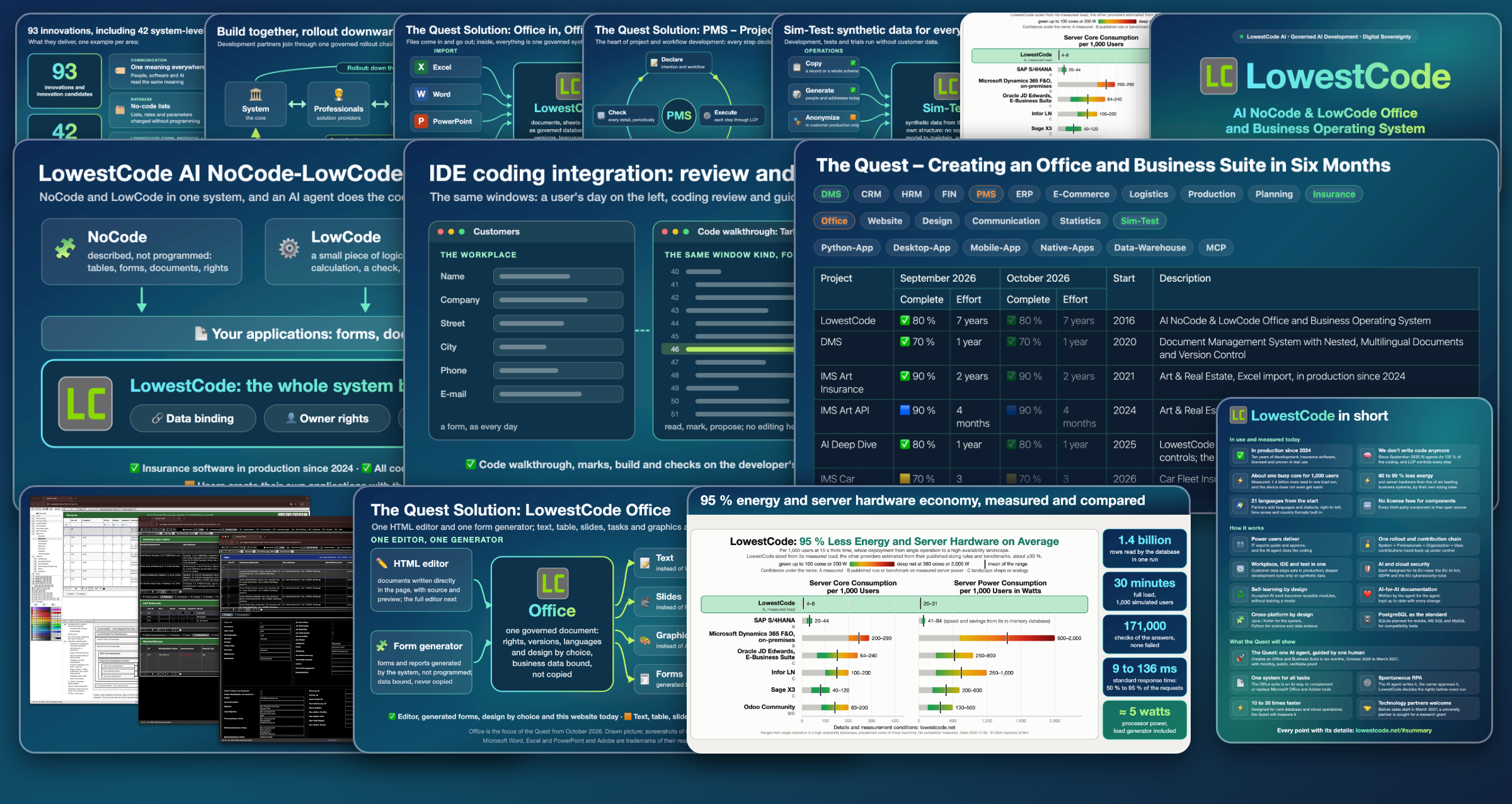 LowestCode at a glance: twenty pictures in one
-
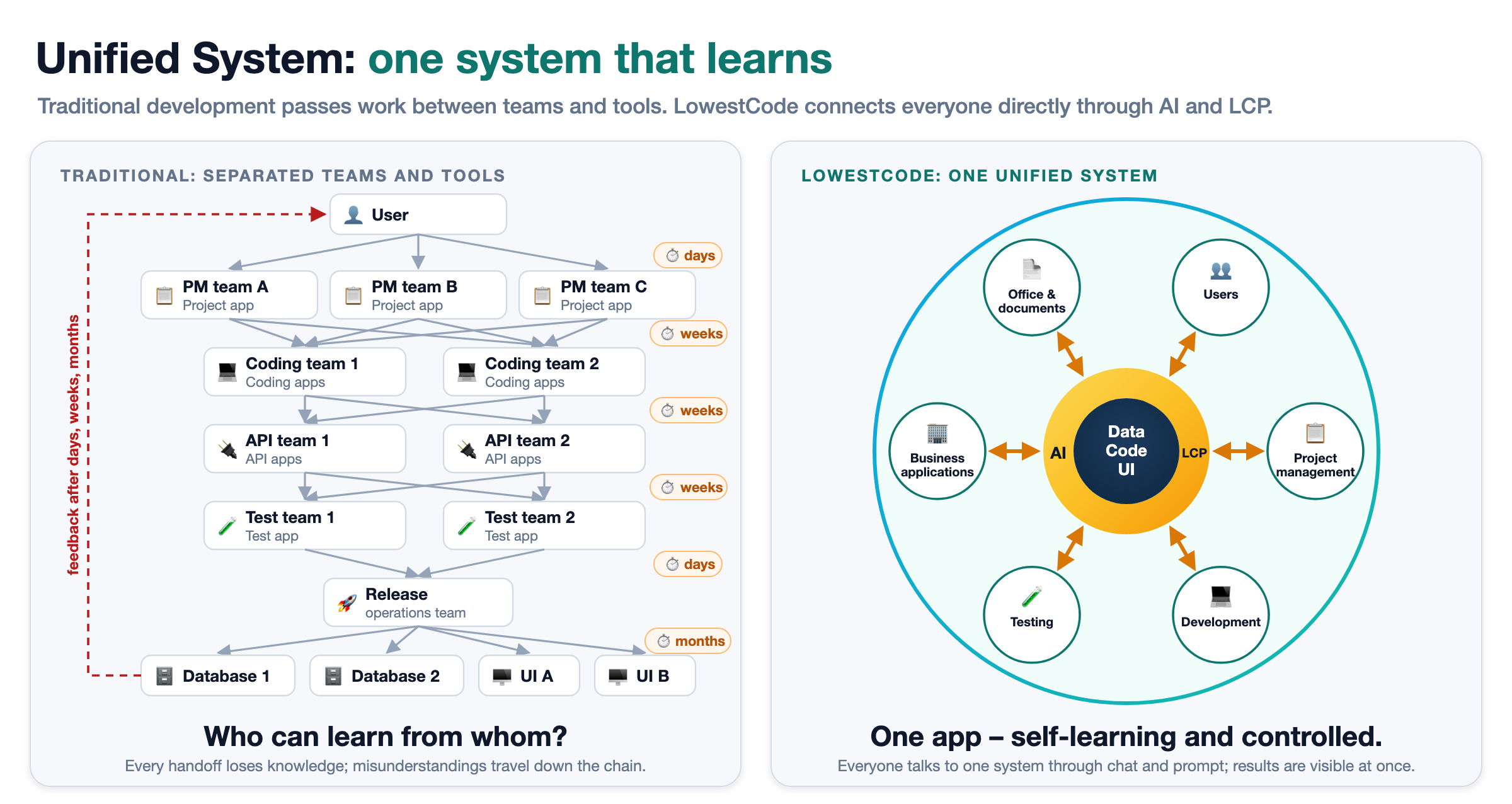 LowestCode Unified Development System:
Coding, project management, testing 100 % by AI & LCP -
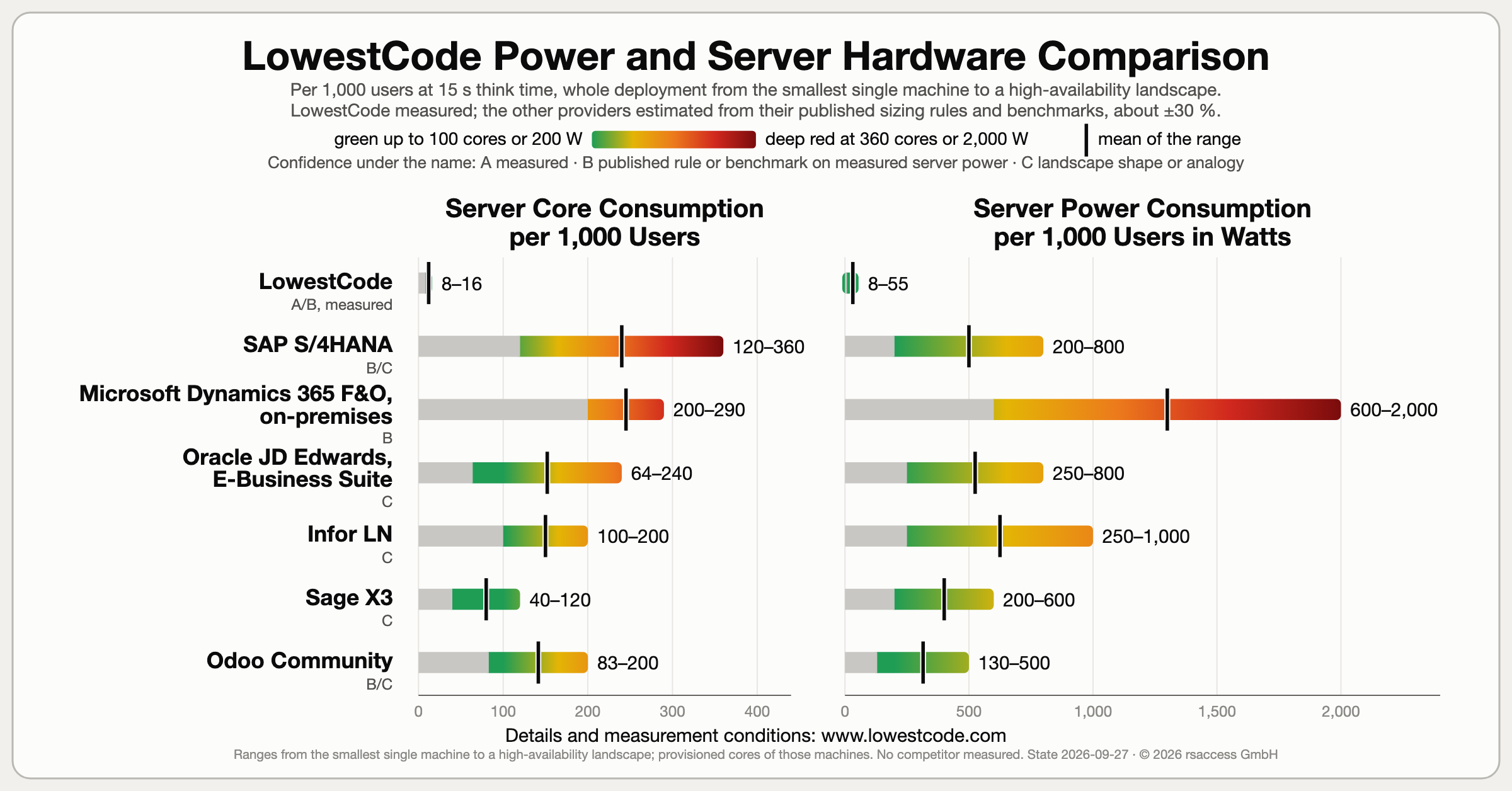
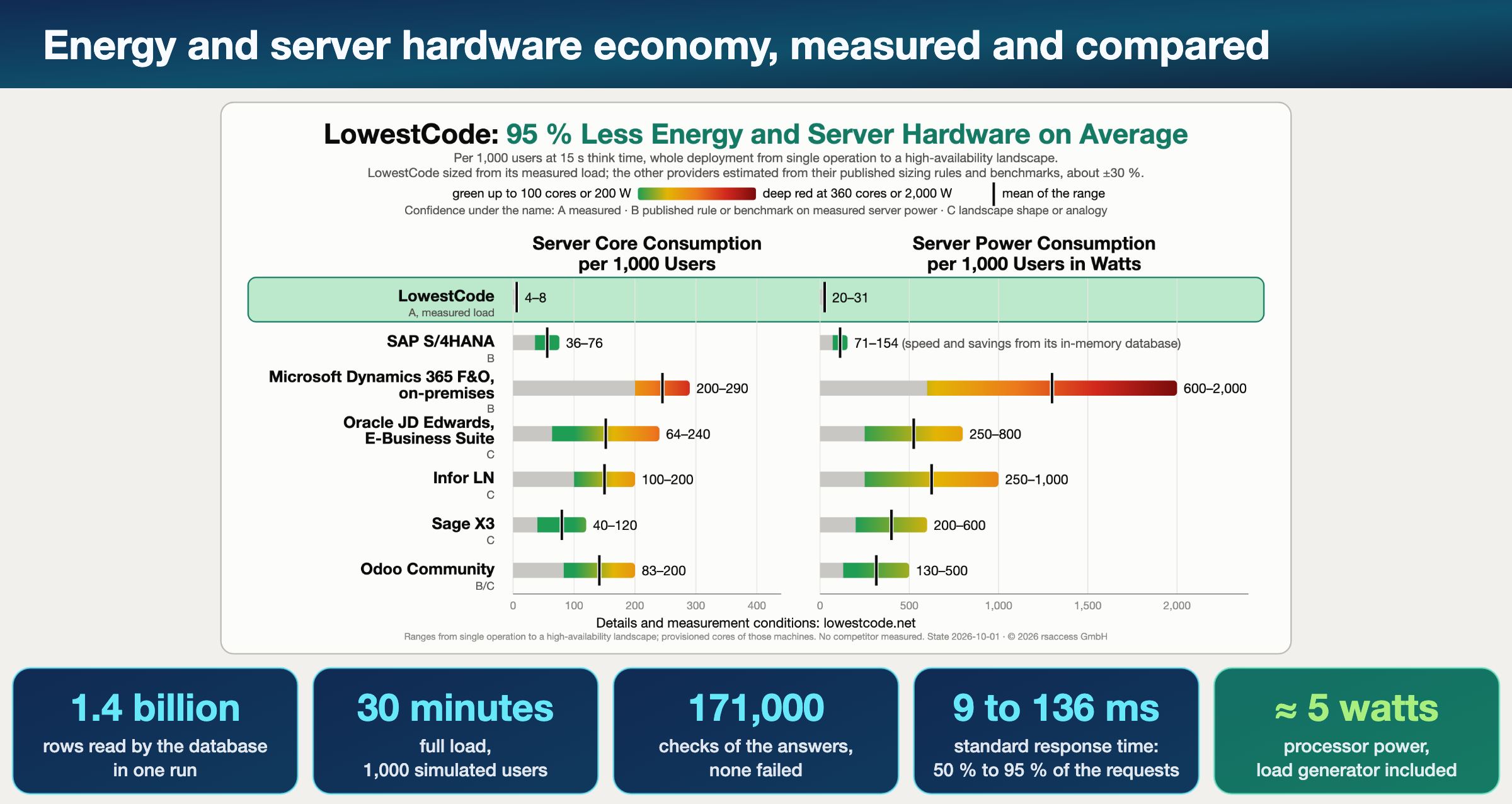 Energy and server hardware per 1,000 users
-
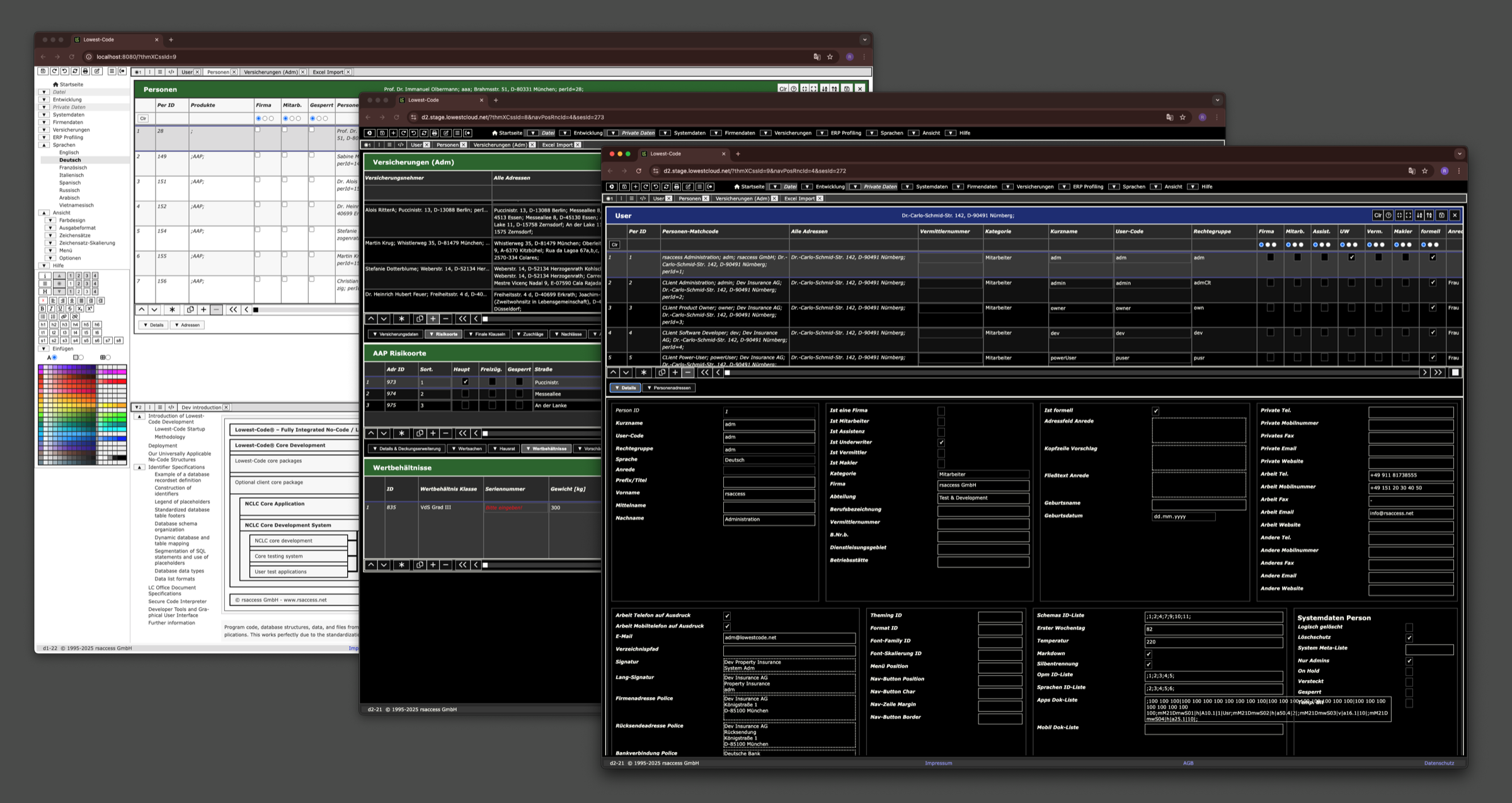 The workplace: several windows of one system side by side, in three themes
-
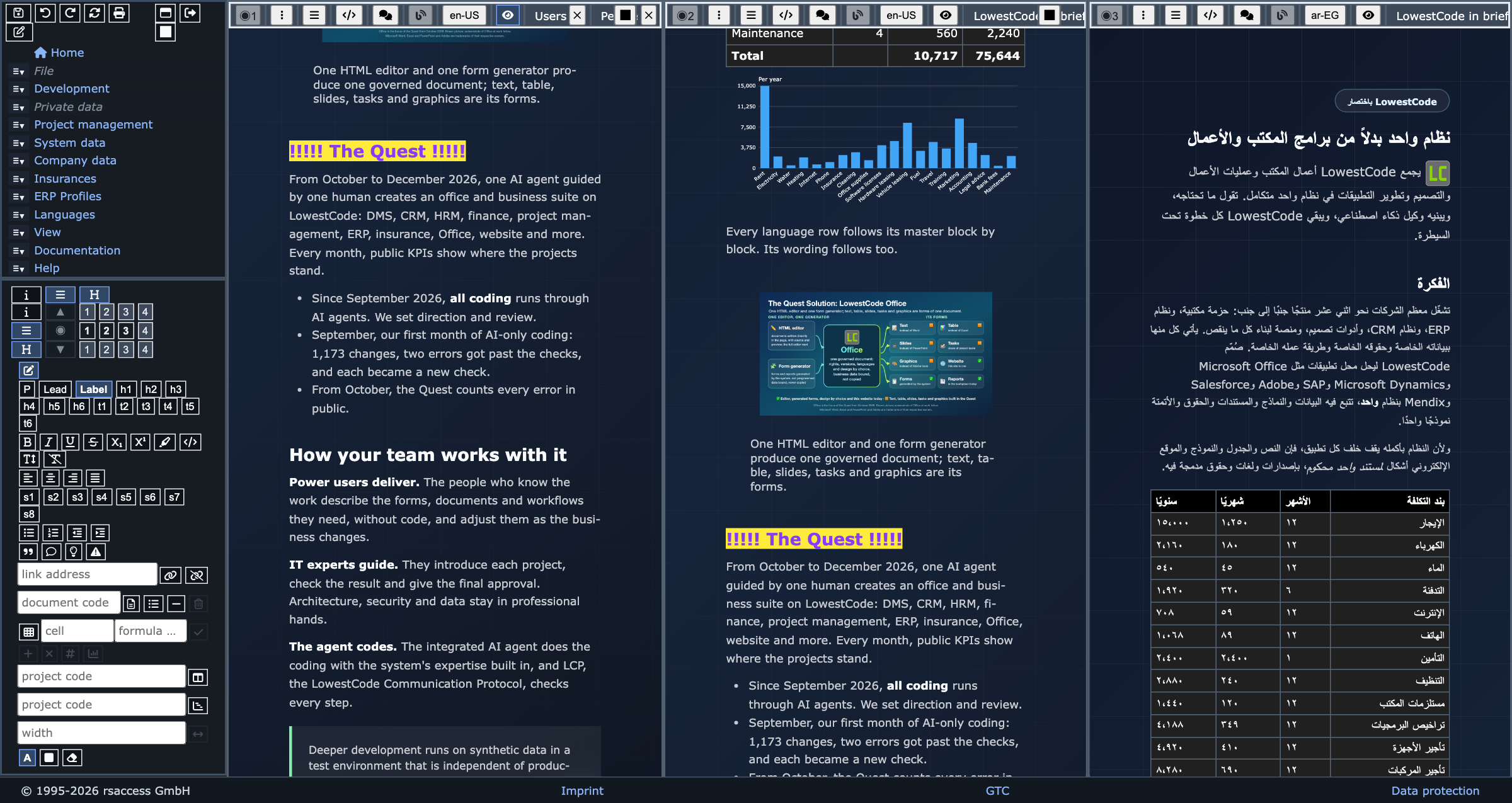
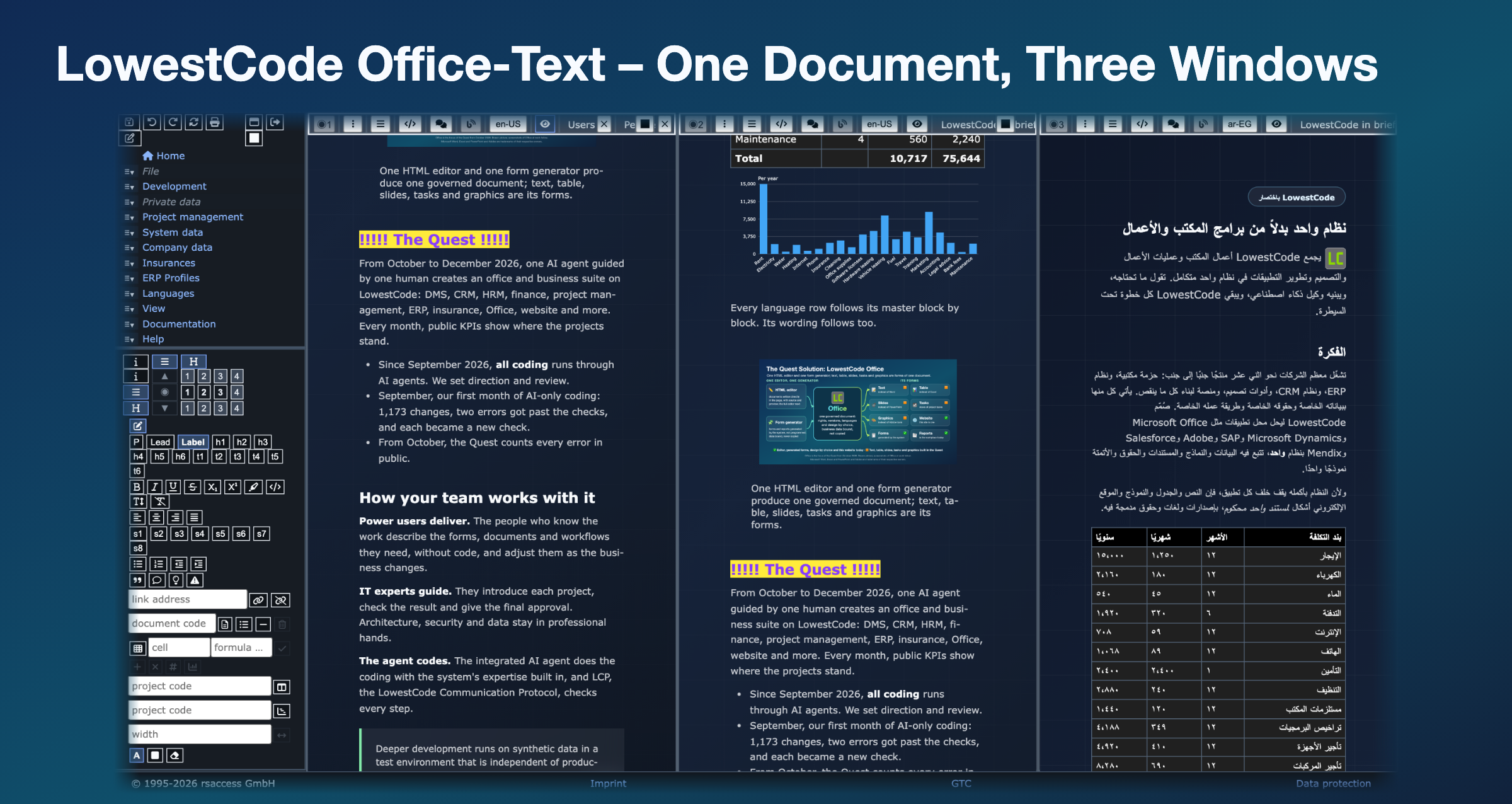 LowestCode Office-Text at work: one document in three windows, each scrolled on its own, built for full RPA
-
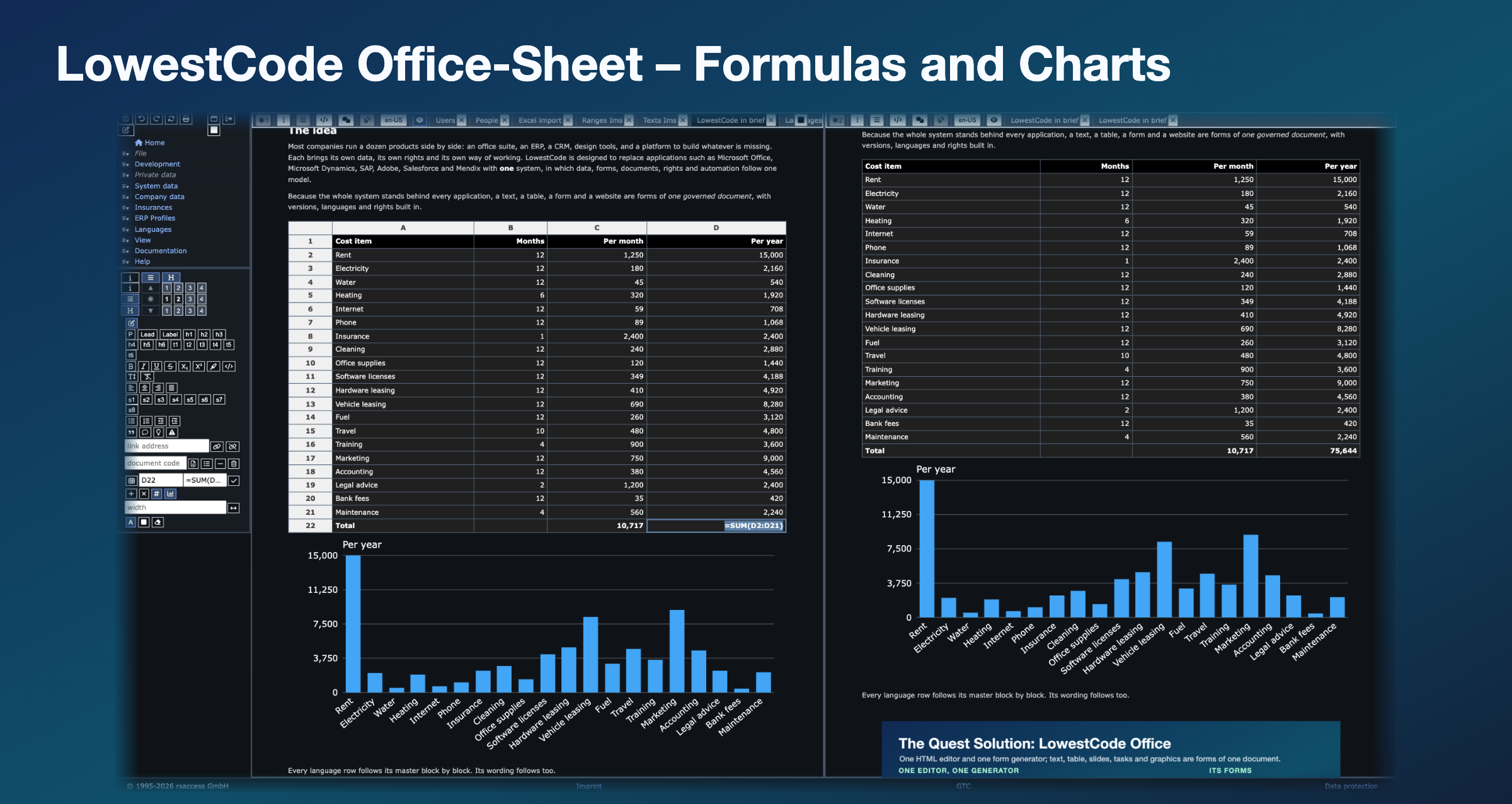 LowestCode Office-Sheet: a sheet with formulas and a chart inside the document, built for full RPA
-
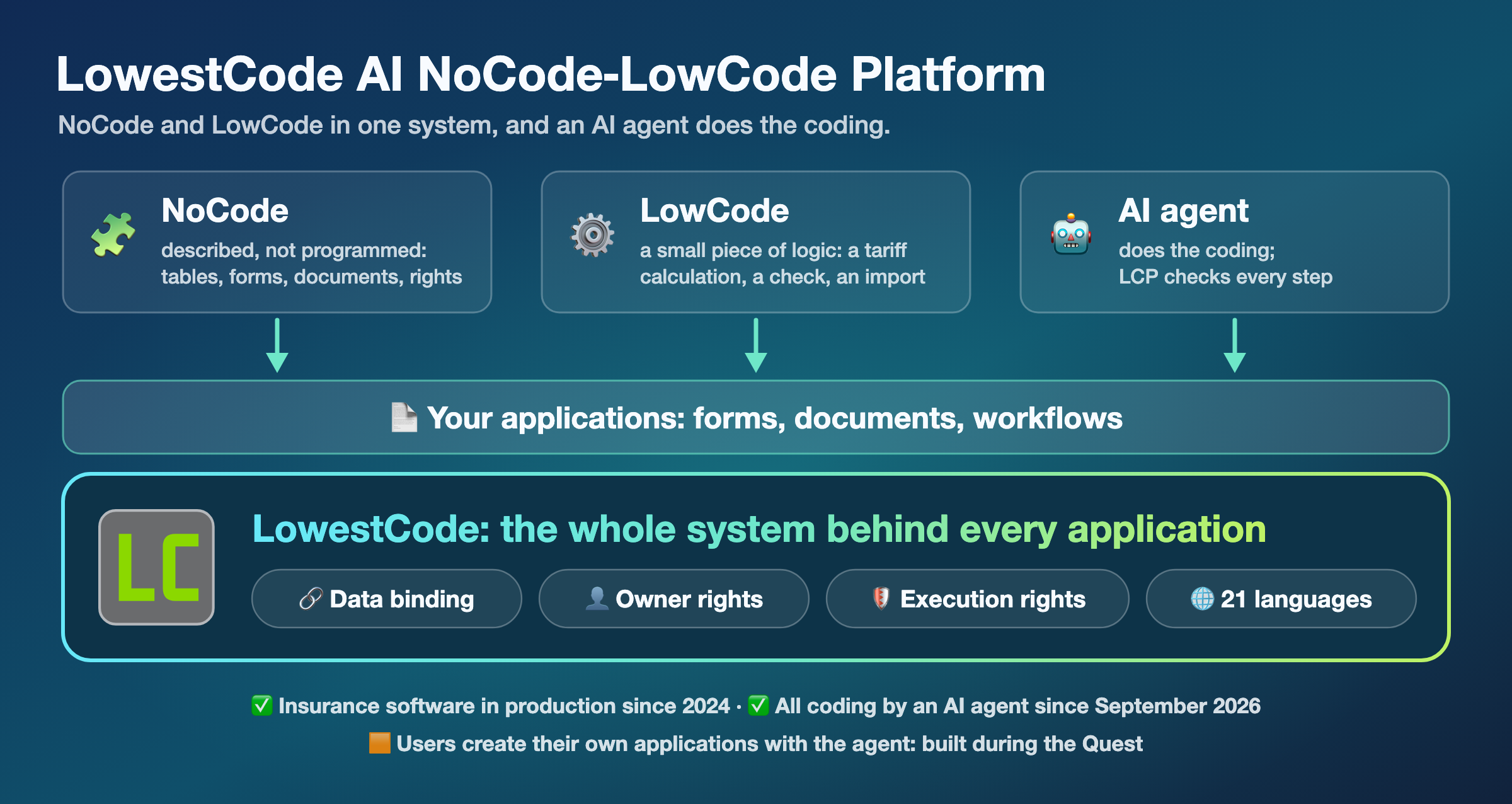 NoCode, LowCode and AI: the whole system behind every application
-
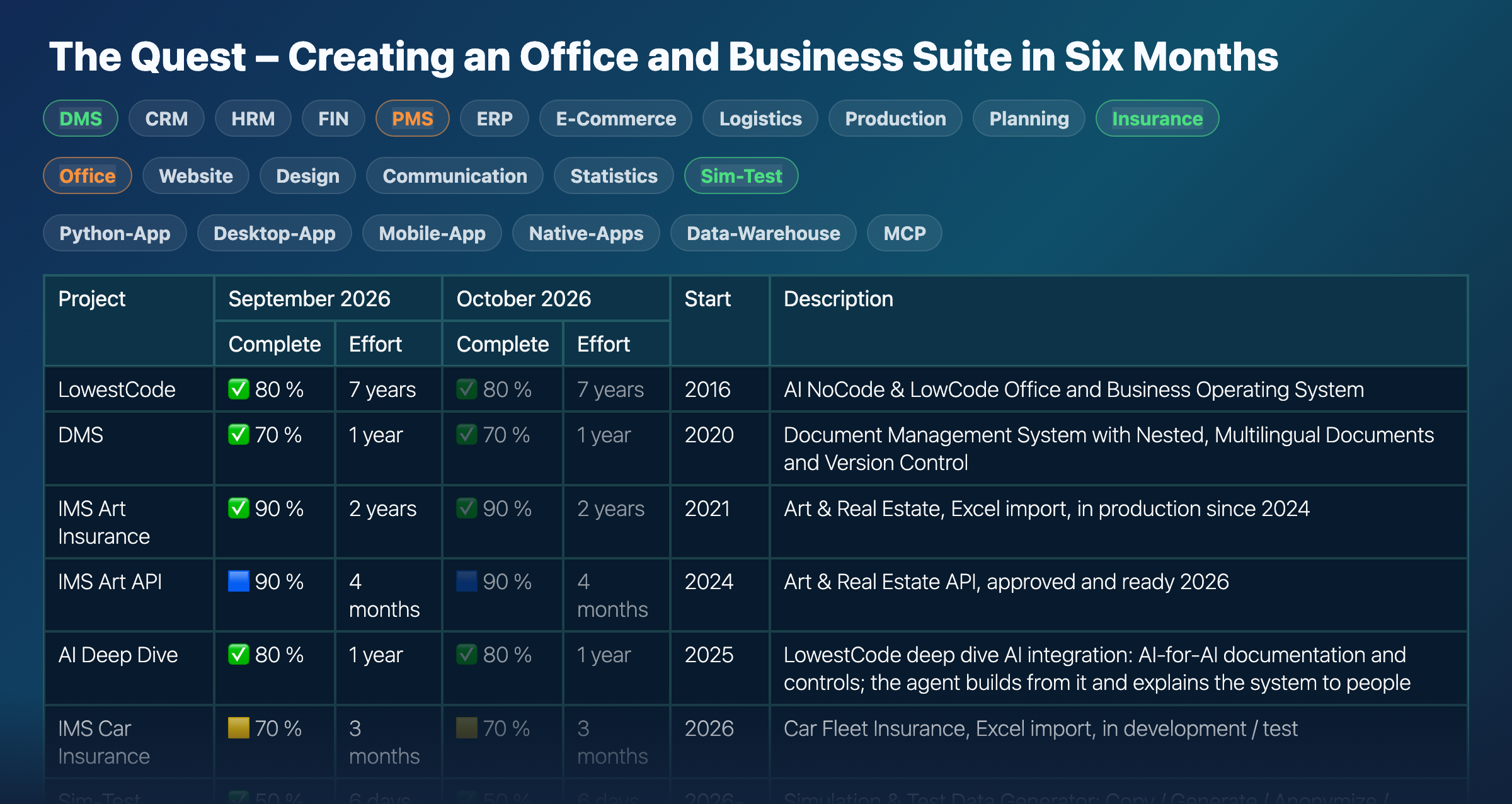 The Quest – updated every month
-
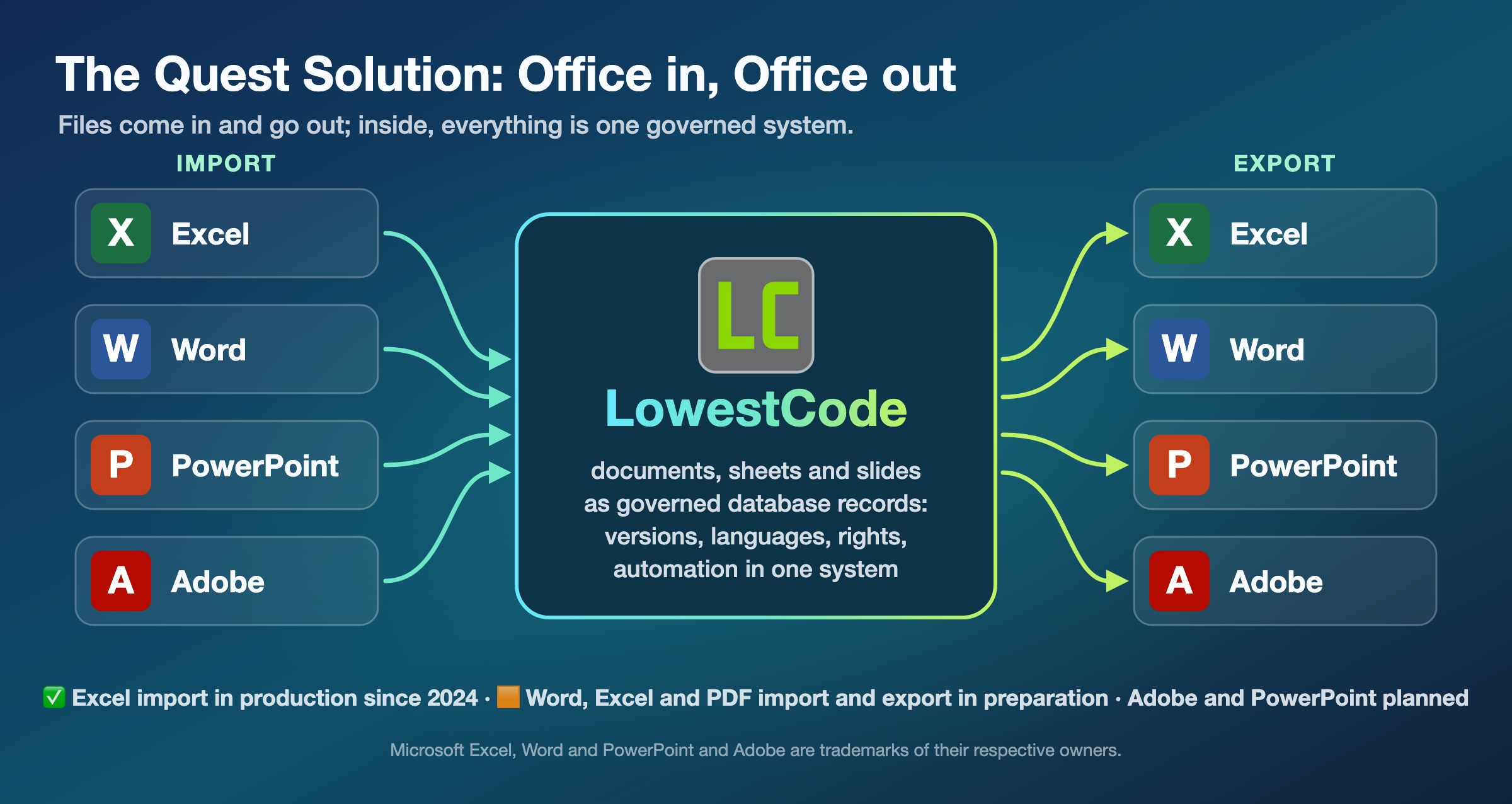 Import and export with Office tools
-
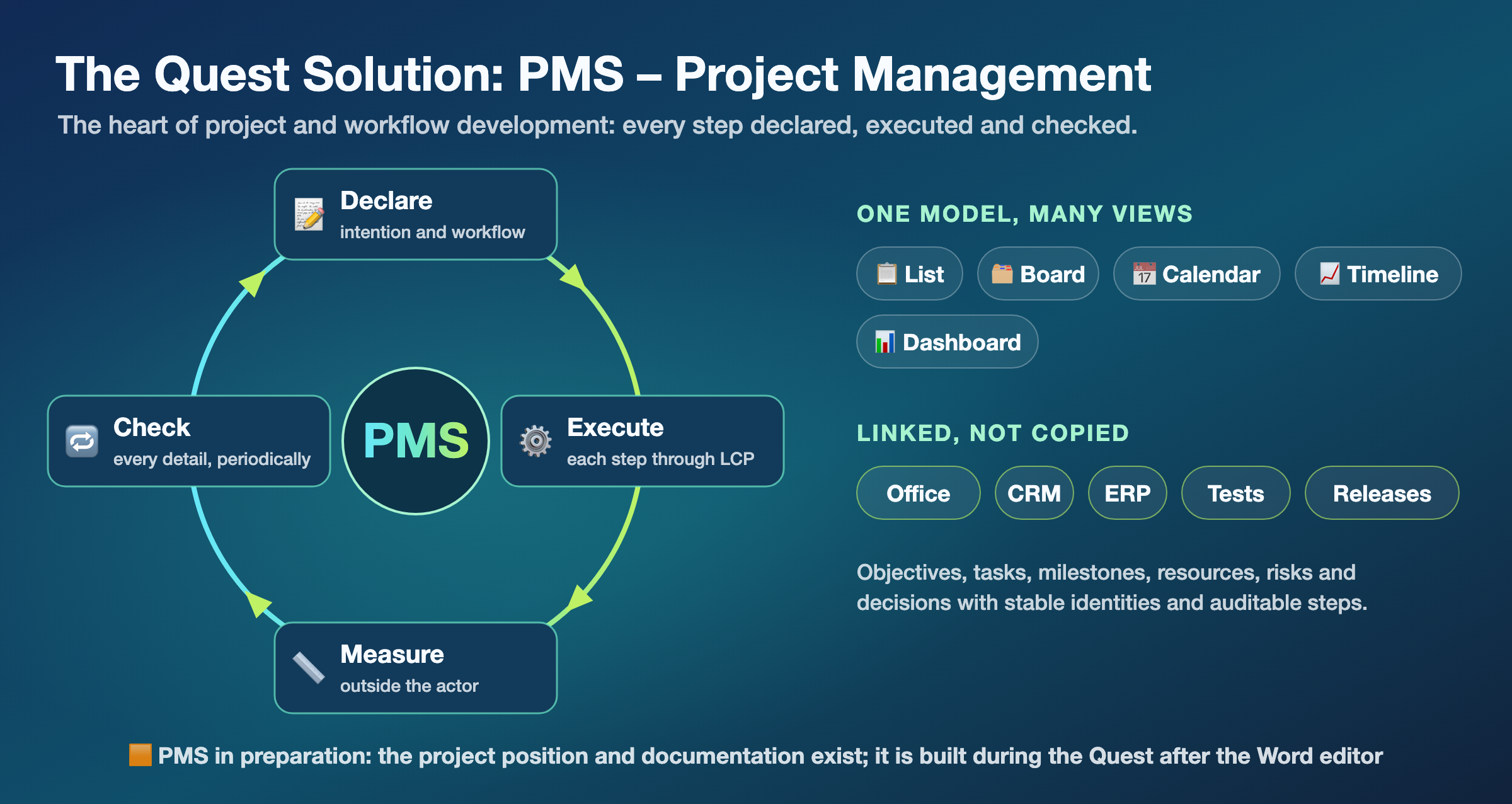 PMS: projects and workflows, declared and checked
-
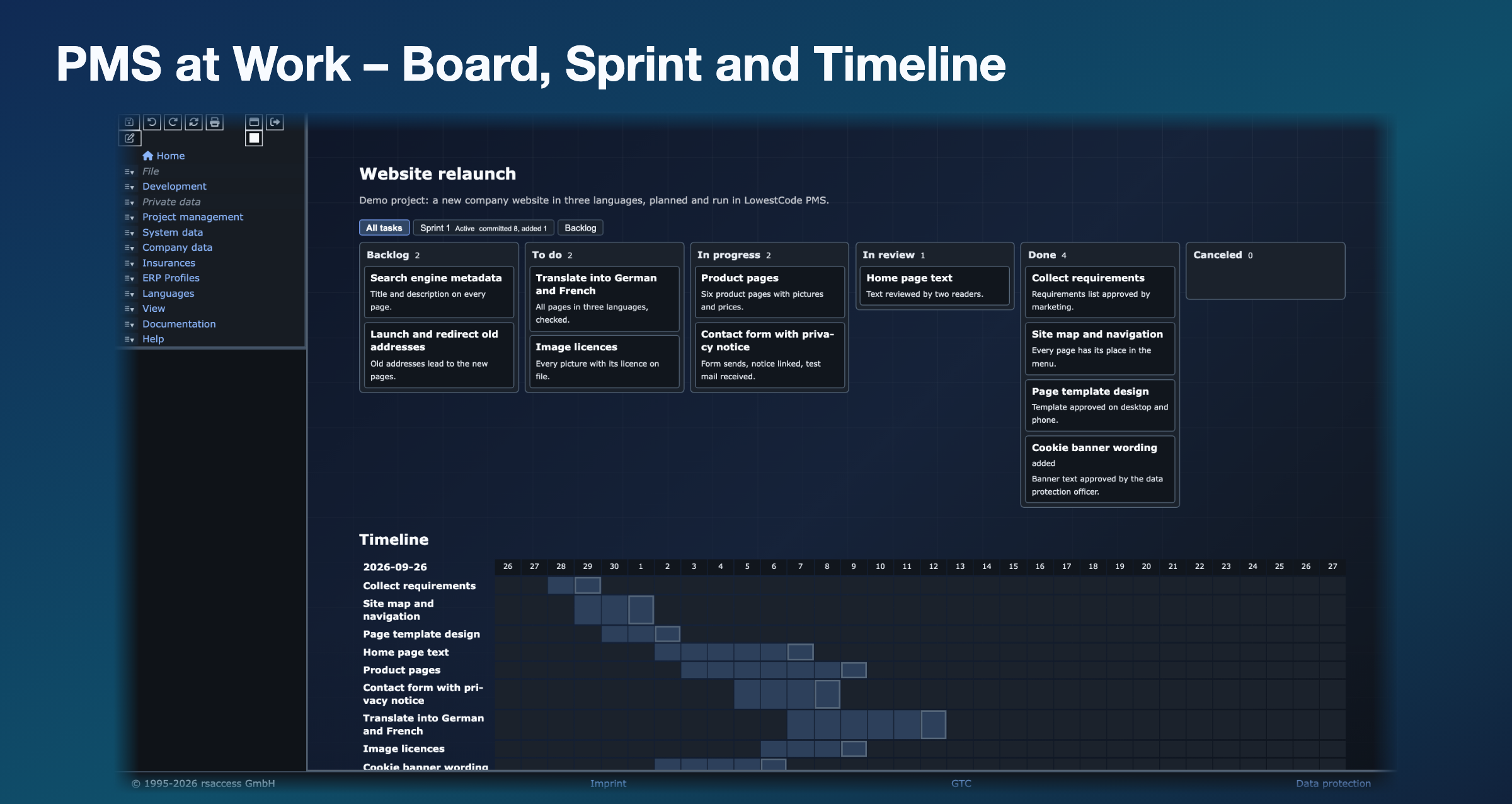 PMS at work: a demo project on the board, with its sprint and timeline
-
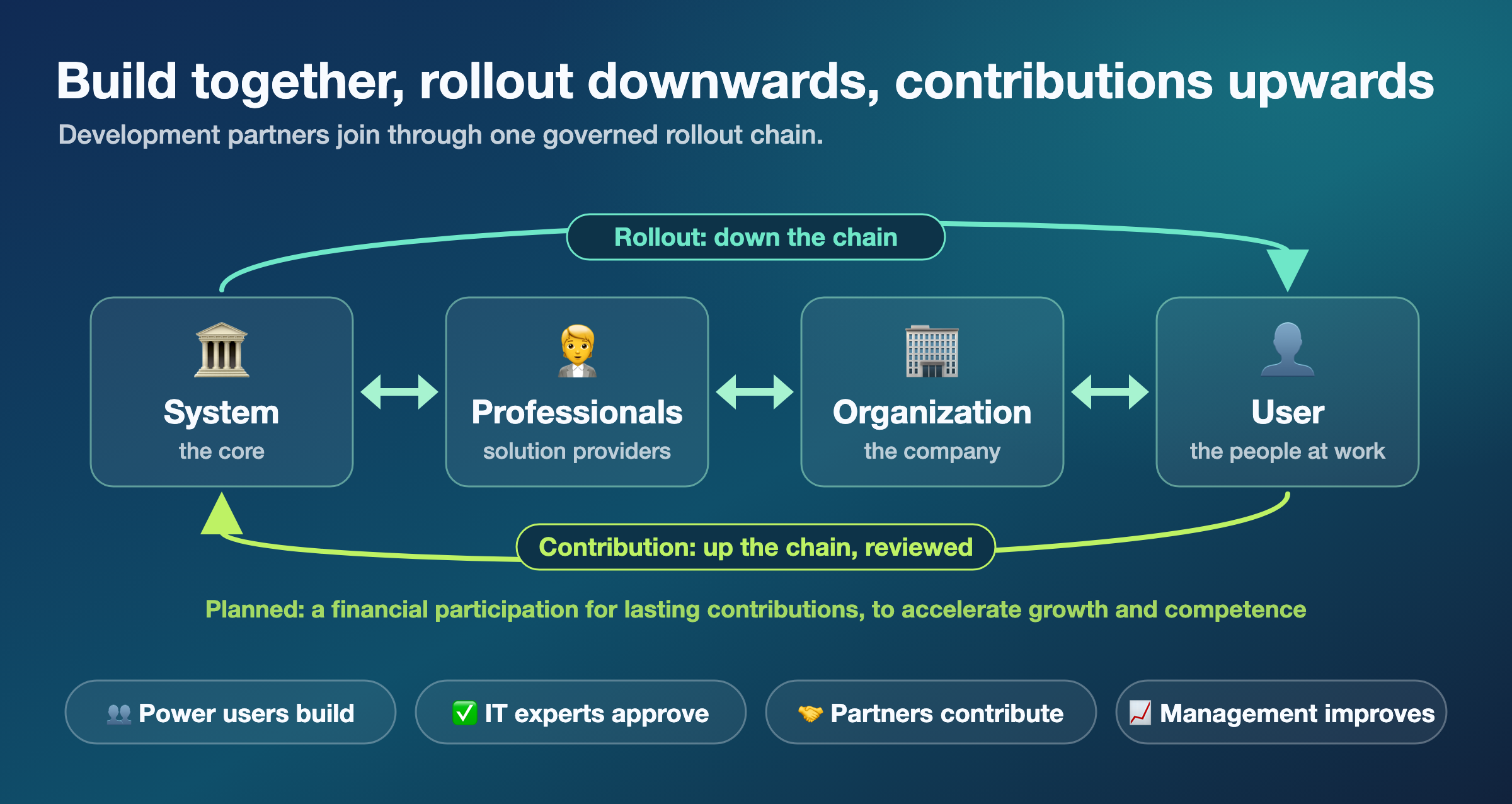 The rollout and contribution chain
-
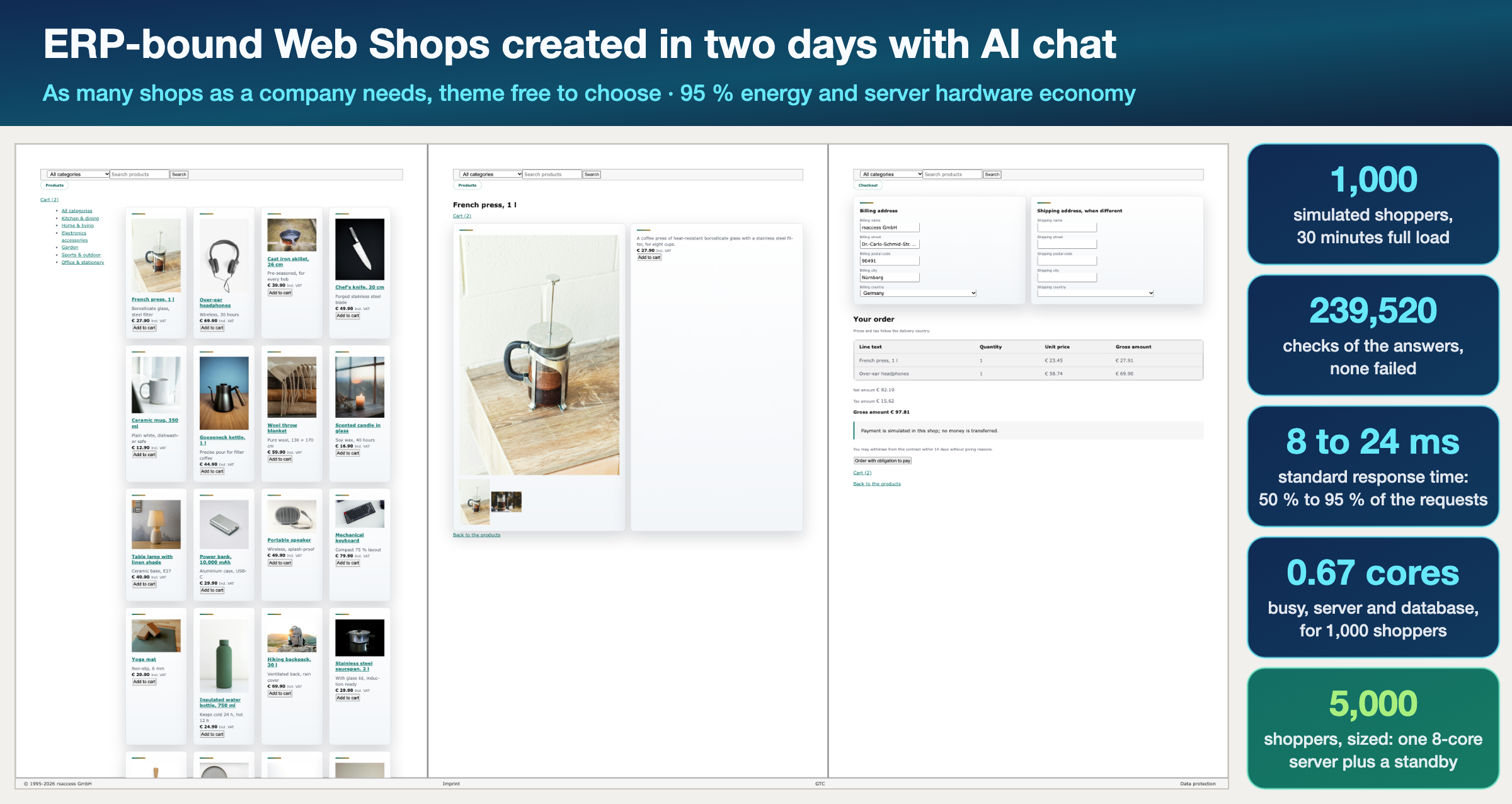 ERP-bound web shops, created in two days with AI chat and load-tested.
-
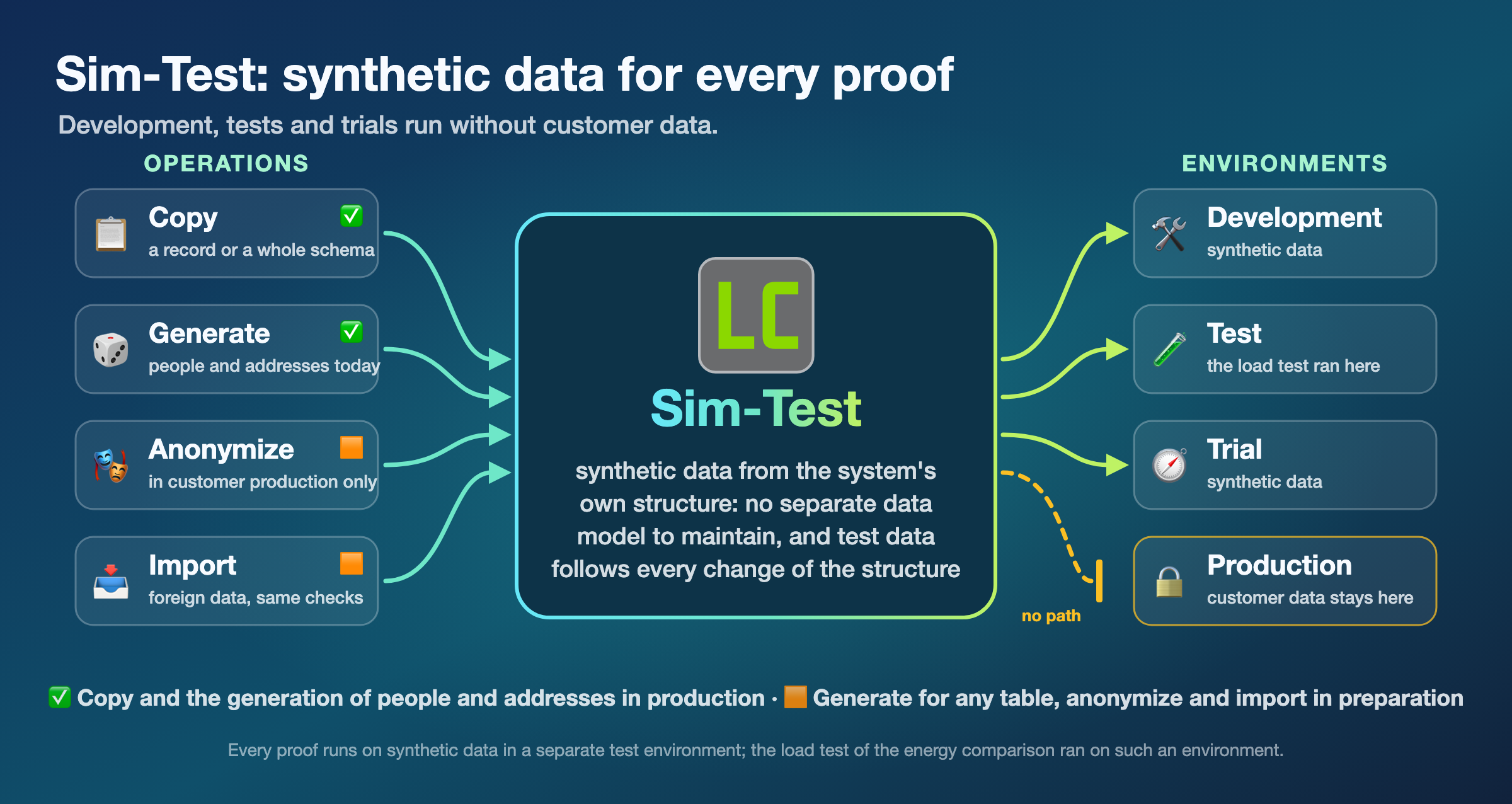 Sim-Test: synthetic data for development, test and trial
-
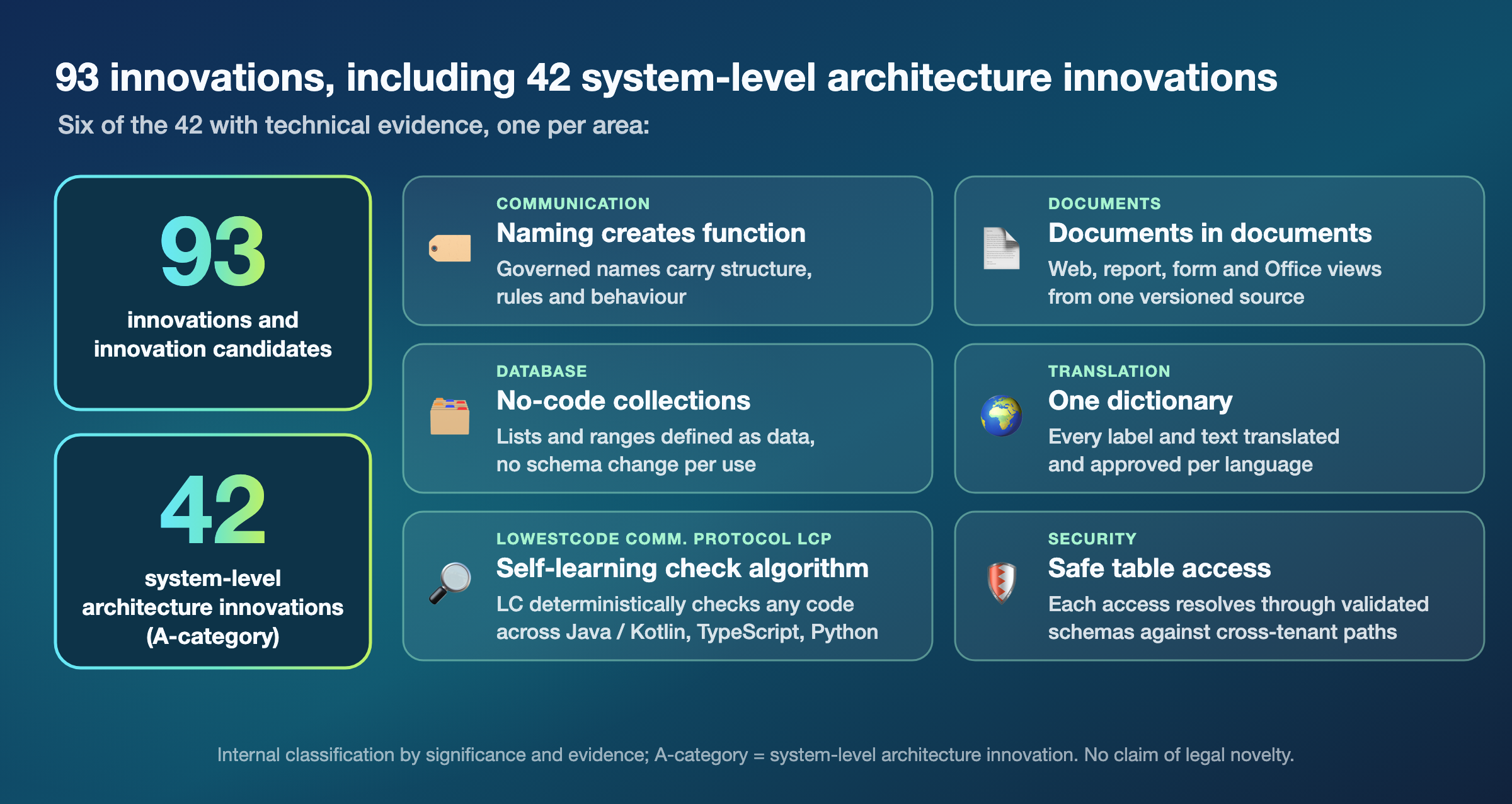 Innovation and cooperation
One system to replace your office and business software.
LowestCode is designed to replace applications such as Microsoft Office, Microsoft Dynamics, SAP, Adobe, Salesforce and Mendix, bringing office work, business operations, design and application development into one integrated system.
Users will adapt and optimize their workflows and applications by talking with the integrated AI agent. The agent operates under LowestCode's reliable controls, respecting permissions for documents, forms and users.
Lightweight, clean and fast, 95 % average energy and hardware economy, designed for secure operation in the European cloud or on desktop, with a focus on EU data protection, cybersecurity and AI requirements.
All product names are trademarks of their respective owners.
- Powered by our NoCode & LowCode system.From private users to companies of every size. Ten years of development. Platform in production since 2024.
- Office and business on one shared modelBusiness data, documents, rights and versions together. Integrated office tools with multiple windows side by side. Secure AI chat and RPA assist you in every workflow. 21 languages included from the start. Power users build by chat. IT experts guide and audit.
- The AI agent codes. LowestCode controls.100 % of coding, project management and testing by AI & LCP. Business workspace, development IDE and testing in one system. Live RPA coding backed by self-learning system knowledge.
- The workplaceOne workplace, one development IDE, many windows. From a single window to a complex working and development environment, the workplace fits the task.
- ERP and e-commerceAn ERP for industry, built on a real industrial business. Sales, purchase and finance work today, production and logistics come in the Quest. Web shops are part of the ERP: their orders flow into stock, logistics and planning.
- Sim-Test: synthetic data for every proofData checks, security, load checks and planning simulations on synthetic data in the shape of your business. Customer data stays in production; developers, testers and the AI agent work on synthetic data.
- SummaryLowestCode in short: what is in use and measured today, how it works and what the Quest will show. We set the direction. AI agents code. LCP controls.
- Documented resource efficiency95 % average reduction in server cores and power. Own load measurements and estimated sizing for six competitors.
The AI agent codes. LowestCode controls. 100 % AI chat execution in one LowestCode system: coding, project management, and testing. Simultaneously, controlled and safe.
Traditional development passes work between teams and tools. In LowestCode all three run 100 % by AI on the NoCode & LowCode (NCLC) system with LCP, in one unified, integral system.
In a traditional setup the user explains a need to project management teams, each with its own project app; they coordinate with coding, API and test teams, each with its own apps; the result lands in separate databases and screens, and the feedback returns after days, weeks or months. Who can learn from whom? In LowestCode, data, code and UI form one core, and every party works with it through the same conversation, AI and LCP, by chat and prompt: results become visible at once, and everything accepted stays in the system and serves the next task.
Working today
The AI agent codes, manages the project tasks and tests on NCLC under LCP control, and development and tests run separately from production; we set direction and review. Documents are discussed and changed by chat, and automations are written by the agent and approved by their owner.
Built in the Quest
Users change their forms and create their own applications by chat, under the same controls and rights.
Why it matters
Data, code and UI are one core, so the agent works on the real thing; the project tasks live in the same system as the code they change, and LCP checks each request before it runs. Without handoffs between teams and tools, nothing is lost on the way, and what the system learns once serves every user. For a company that means fewer licenses, interfaces and data silos.

- One core: data, code, UI
- 100 % by AI & LCP
- NCLC & LCP as the basis
- Safe test environment
- Chat and prompt
- Self-learning
- Controlled
The Quest.
One agent builds.
LowestCode controls.
Three months, October to December 2026, with monthly KPIs as public, verifiable proof.
One AI agent creates DMS, CRM, HRM, FIN, PMS, ERP, Insurance, Office, Website, Design, Communication, Statistics, Sim-Test, and more on LowestCode AI. The LowestCode Communication Protocol (LCP) controls coding and execution in every phase.
We don't write code anymore
Since September 2026, coding, project management and testing safely run 100 % by AI chat. The basis is the NoCode & LowCode (NCLC) system combined with LCP: it conditions the agent and answers every step with live feedback, LCP checks each request before it runs, and development and tests run separately from production. We set direction and review. September, our first month of AI-only coding: 1,173 changes, two errors got past the checks, both in work on the core, and each became a new check. From October the Quest counts every error in public. Users and developers will create applications the same way. Today one person does this work: the founder sets direction and reviews, the agent codes. The platform under it is ten years of development, with much input from real projects.
What the Quest will prove
Safe and controlled AI-only coding is reality and delivers.
One system for all common Office and business tasks.
Qualified AI / human error statistics: once obvious errors are handled, a remaining error is as often a definition, a preparation, or a human error as the AI's.
95 % less energy and server hardware on average, compared with six leading business systems; SAP comes closest with in-memory.
Green AI: less effort and energy for AI application creation, because fixed system operations replace repeated AI reasoning and each task runs on the lightest sufficient model setting.
10 to 30 times faster for core database and cloud operations, compared with the same stacks.
AI and cloud security with data protection, each designed for its EU rules: the EU AI Act for the AI, GDPR and the EU cybersecurity rules for the cloud.
A better user interface with multiple windows and built-in AI support for documents and coding.
21 application languages from the start.
An application, not a suite
A suite bundles separate products, a word processor beside a spreadsheet, an ERP beside a CRM, each with its own data, rights and screens, joined by interfaces. LowestCode is one application: documents, sheets, business data, rights and versions live in one shared model, so a new part extends the application instead of adding a product to connect.
Where our projects stand As of
- DMS
- CRM
- HRM
- FIN
- PMS
- ERP
- E-Commerce
- Logistics
- Production
- Planning
- Insurance
- Office
- Website
- Design
- Communication
- Statistics
- Sim-Test
- Gaming
- Python-App
- Desktop-App
- Mobile-App
- Native-Apps
- Data-Warehouse
- LCP-MCP
Project | September 2026 | October 2026 | Start | Description | ||
|---|---|---|---|---|---|---|
Complete | Effort | Complete | Effort | |||
LowestCode | ✅ 80 % | 7 years | ✅ 80 % | 7 years | 2016 | Green AI NoCode & LowCode Office and Business Operating System |
DMS | ✅ 70 % | 1 year | ✅ 75 % | 1 year | 2020 | Document Management System with Nested, Multilingual Documents and Version Control |
IMS Art Insurance | ✅ 90 % | 2 years | ✅ 90 % | 2 years | 2021 | Art & Real Estate, Excel import, in production since 2024 |
IMS Art API | 🟦 90 % | 4 months | 🟦 90 % | 4 months | 2024 | Art & Real Estate API, approved and ready 2026 |
AI Deep Dive | ✅ 80 % | 1 year | ✅ 80 % | 1 year | 2025 | LowestCode deep dive AI integration: AI-for-AI documentation and controls; the agent builds from it and explains the system to people |
IMS Car Insurance | 🟨 70 % | 3 months | 🟨 80 % | 3 months | 2026 | Car Fleet Insurance, Excel import, in development / test |
Sim-Test | ✅ 50 % | 6 days | ✅ 50 % | 6 days | 2026-04 | Simulation & Test Data Generator: Copy / Generate / Anonymize / Import |
LCP-Chat | 🟨 40 % | 5 days | 🟨 50 % | 6 days | 2026-08 | LowestCode Communication Protocol: Document & Automation AI Chat; System Chat in preparation |
Office-Text | 🟧 20 % | 10 days | ✅ 40 % | 14 days | 2026-08 | LowestCode Office Text Documents with Word & PDF Import/Export |
Office-Sheet | 🟧 10 % | 5 days | ✅ 40 % | 6 days | 2026-08 | LowestCode Office Table Documents with Excel Import/Export |
PMS | 🟧 5 % | 2 days | ✅ 45 % | 4 days | 2026-09 | Project Management System - our own development runs through it since October 2026 |
LCP-MCP | – | – | ✅ 40 % | 1 day | 2026-09 | LowestCode Communication Protocol: controls coding and execution, every step checked and the rights decided before it runs; MCP adapter in preparation |
Office Website | – | – | ✅ 25 % | 2 days | 2026-09 | LowestCode Office Websites as documents, written by the AI agent; this website runs on it |
ERP | – | – | 🟨 30 % | 2 days | 2026-10 | Enterprise Resource Planning with its web shop and finance: products, prices, taxes, sales and purchase documents, stock ledger and archive, the roots for production |
ERP Web Shop | – | – | ✅ 60 % | 4 days | 2026-10 | Web shops inside the ERP: catalog, cart, checkout and orders, any number per company; payment simulated |
Office Design | – | – | ✅ 30 % | 3 days | 2026-10 | Themes, formats and fonts generated from the database: one design for website, documents and shops |
FIN | – | – | 🟨 30 % | < 1 day | 2026-10 | Finance: every invoice, credit note and payment of the ERP posts its journal entry; trial balance and open items |
Office-Table | – | – | 🟨 35 % | < 1 day | 2026-10 | LowestCode Office Tables in documents: cells, rows and columns edited in place, ranges pasted from Excel; bound tables filter by value |
… | … | … | … | … | … | More projects to start soon |
✅ In production · 🟦 Ready · 🟨 In test · 🟧 In preparation · ❌ Canceled
September 2026 shows the start values of the Quest, October 2026 the current values. Completeness is estimated, effort is the working time spent, rounded; a dash marks a project that joined the table during the Quest. A value that did not change since the month before is shown muted.
… The table is open: a planned project gets its row when work on it starts, and the table grows until every planned project is built out.
The Quest Summary What each project has reached, and what it took, as of .
🟧 LowestCode Office
Text, tables, sheets, project views, figures, vector graphics and design pages are written in the page, every print is a PDF beside its document, and this website and its design come from the same system. The remaining tool sets, presentations, and Word, Excel and PDF import and export come in the Quest; the state of every tool set stands under Office tool sets.
✅ DMS
Documents with versions, languages and rights in one store. Since October, external files are documents too, pictures with their small previews and 3D models, and the document manager finds, previews and opens every document a person may see. Effort: 1 year.
✅ PMS
Our own development runs through it since October: tasks, board, timeline, calendar, sprints and burn-down. The agent claims its tasks, and a step closes on a measurement, not on the agent's word. Effort: 4 days.
🟨 ERP
Products, prices and taxes, and the sales and purchase documents from the offer and the request to the credit note: each turns into the next, takes its number and taxes and prints as a letter, deliveries and receipts book their stock moves, and every invoice posts its journal entry. Its industrial example is a metal profiling business, with its real products, parts lists and packaging in the system. Production, logistics and planning come in the Quest. Effort: 2 days, its web shop and finance beside it.
✅ ERP Web Shop
The AI agent created the shop by chat in two days: the product, price, tax and order structure of the ERP, the cart and checkout actions, the shop pages and a first load test. Since then the shop prices gross, a paid and shipped order gets its invoice from the ERP documents, and the customer sees the documents of the order. Effort: 4 days with pictures and load tests.
✅ Sim-Test
Copies records and whole company data sets, generates repeatable data sets of users, customers, offers and a product catalog, and creates a test environment in one step. The load tests on this page ran on its data. Effort: 6 days.
From proven workflows to maintainable applications Modernize business-critical workflows without losing proven business logic.
We transform insurance processes, enterprise workflows, Excel workbooks, and VBA applications into maintainable software for European cloud and desktop environments. LowestCode begins with the business logic that already creates value and gives it a controlled path forward.
-
Insurance
Products, calculations, documents, and processes developed around real operational needs.
-
Excel & VBA
Valuable workbook logic moved into maintainable, shared applications.
-
Enterprise workflows
Data, forms, rights, documents, and automation brought into one model.
-
European deployment
Cloud, private, and desktop options, designed for EU data protection and conformity.
- Preserve business logic
- Reduce fragmentation
- Control change
- Support long-term use
Power users deliver.
IT experts guide.
Development partners join through one governed rollout chain.
The LowestCode rollout system lets development partners build independently without interfering with one another, as the integrated AI agent does the coding and keeps it consistent.
- System
- Professionals
- Organization*
- User
Contributions travel up the chain in a controlled way. Once we are established on the market, we plan a participation system that rewards lasting contributions.
- User
- Organization*
- Professionals
- System
In addition, every partner installation rolls out from local development to production, in practice since 2024.
* In LowestCode development, the Organization level is played by the Assurance insurance use case, in practice since 2024.
-
Power users meet the internal needs
The people who know the work build the forms, documents, and workflows they need, without code, and make adjustments themselves as the business changes.
-
IT experts guide and control
An IT expert introduces each project, advises and accompanies the power user, checks the result, and gives the final approval. Architecture, security, and data stay in professional hands.
The AI agent does the coding, with the system's expertise built in and its checks behind every step. -
IT experts freed for what usually waits
Relieved of routine application work, IT experts take on the higher-level tasks that normally get neglected: integration, security, and intelligent global solutions and helpers for the whole company.
-
A better-run company
Internal needs are met quickly, professional control stays in place, and expert time goes where it counts: an overall improvement of company management and business development.
- Power users build
- IT experts approve
- Partners contribute
- Management improves
LowestCode AI NoCode‑LowCode Platform LowestCode is what AI needs: NoCode and LowCode in one integral, compact system for Office and business applications, and LCP controls every step. The result is controlled agent coding, high coding efficiency, and a clear interface for people.
Productive insurance software has been licensed and used since 2024, with continuing development and integration into established systems. LowestCode preserves proven logic while modernizing how it is operated.
Why LowestCode
What a power user needs without code is what an agent needs: one governed system for data, interfaces, documents, rights, translations, and automation. Guided by LCP, an AI agent is designed to implement faster and more consistently than hand coding; people set direction and review, and system rules retain control.
-
Build without code
The people who know the work say what they need. Your applications will be created and maintained by an AI agent under LowestCode's control, and proven business rules are kept instead of starting from zero.
-
Change safely
Controlled NoCode, LowCode, and AI-assisted changes are validated and can be reversed. Deeper development runs on synthetic data; customer data stays in production.
-
One system
Data, forms, documents, rights, and automation follow one model, so the whole system stands behind every application, with data binding and with owner and execution rights controlled. 21 application languages from the start.
-
Run it your way
European cloud, private environments, or controlled desktop use, with no license fees for components. AI agents and cloud hosting are external services with their own terms.
One workplace.
One development IDE.
Many windows.
One shell for any application, the Office system on its way.
Your windows, ready when you log in
From a single window to a complex working and development environment, the workplace fits the task. Your windows and their layout are saved and preloaded, ready the moment you log in. Working environments can be defined for each task and guarded by rights. Windows sit side by side, and the same document can be open in many of them, working in sync. The same system is your workplace and your development and test environment, so you build your own applications there and test them on synthetic data before they reach production. The test environment is independent of production, separate in data and files, and always available and accessible.
One menu, two views, one toolbar
The navigation is one menu shown two ways, as a side tree or as a top menu. The side menu doubles as the toolbar, with the HTML editor's controls in it, as on the left of the picture. Themes and formats change the look, not the content.
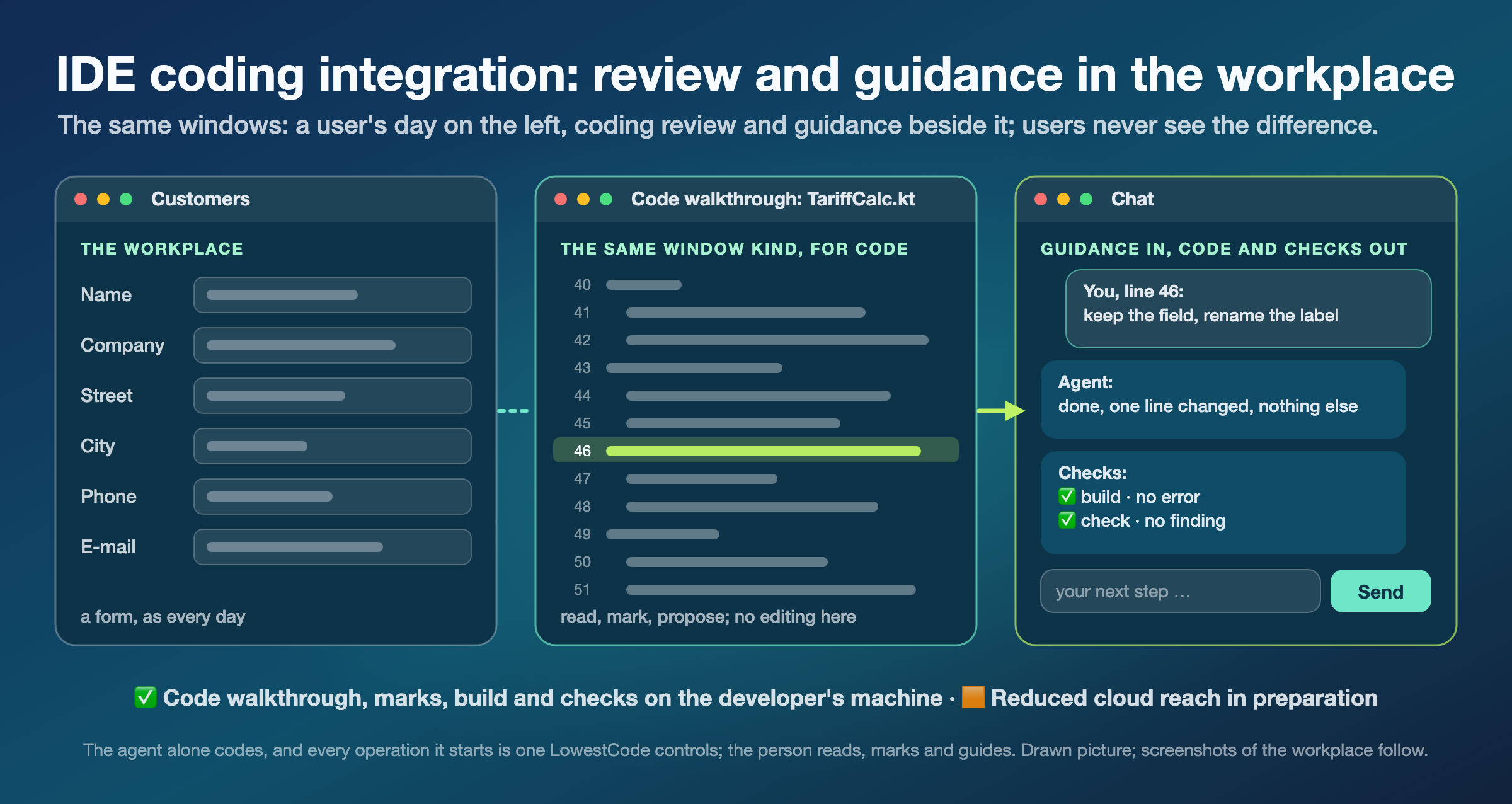
The development IDE inside the workplace The same windows for a user's day and for coding review and guidance; users see only the workplace.
The development IDE is not a separate program. It uses the same multi-window workplace: the code walkthrough opens beside the forms and documents of the day, visible to developers by rights and invisible to everyone else. The chat is the same door for everyone, a user asking about a document, a power user requesting an automation, a developer guiding the coding, and the rights decide what each one reaches. Users work in the normal workplace and never meet the coding capability.
Chat in every document and form
Every document and every form carries its chat with the agent: you ask about the content, the agent explains and proposes, and the person decides what is applied. The owner's and the user's rights apply to what the agent reads: it receives only what the system releases into the request. Today the chat runs in development, where no customer data exists; whether the agent works on documents in production is each customer's decision.
Execution requests
An automation is written by the agent in the chat when it is needed, the owner approves it, and LowestCode checks it and decides the rights before every run; an approved automation runs again on demand, without the agent. On the developer's machine the chat reaches every operation of the system, system coding included; in the cloud it is designed to start only what the cloud runs.
Coding review and guidance
In the code walkthrough the person loads a source file, marks a line or a passage, and writes in the chat what to change; the agent alone codes. Every change is built and checked right away, and the result stands in the conversation, file and line. The agent runs no command of its own; every operation it starts is one LowestCode controls.
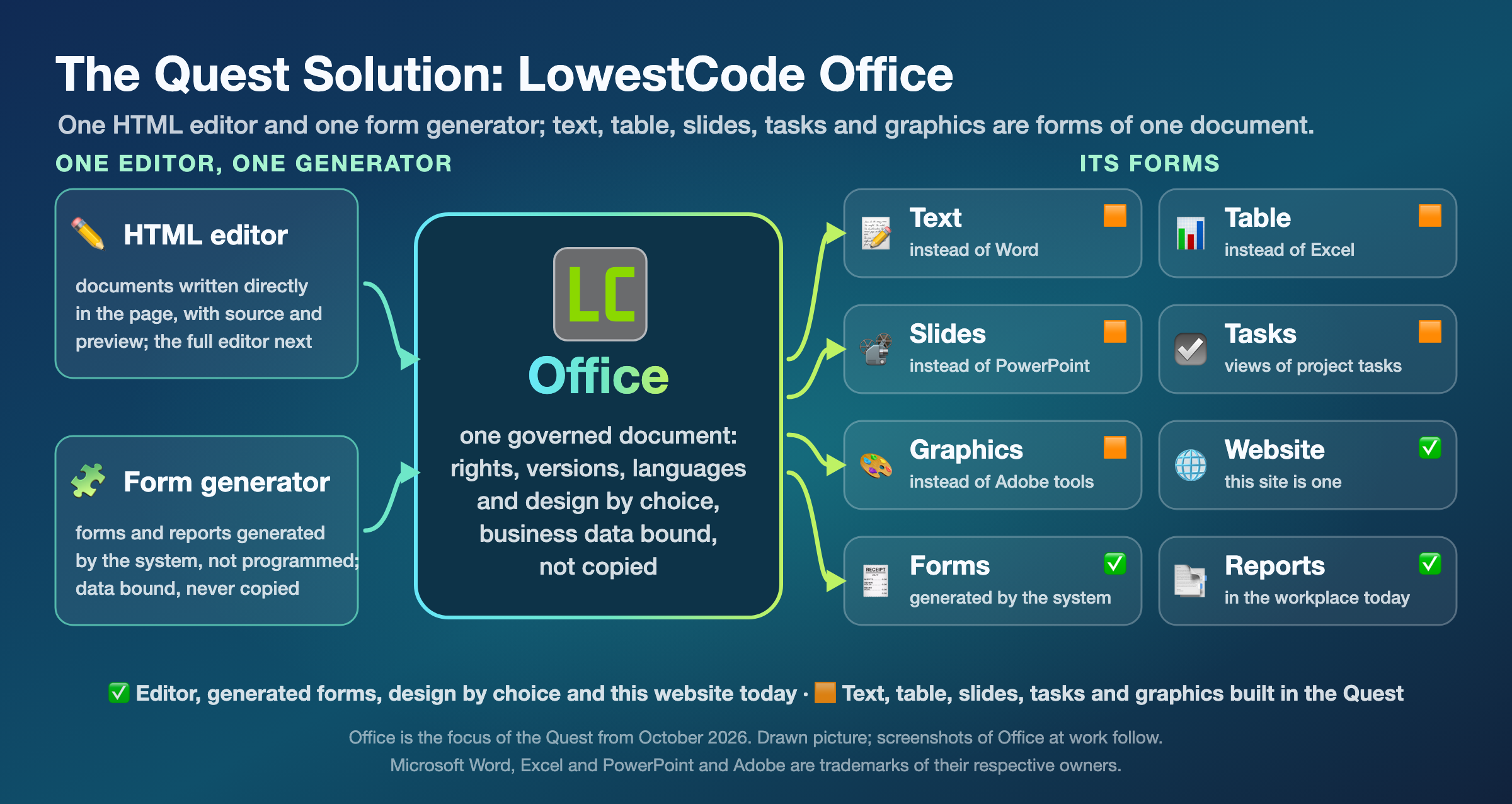
LowestCode Office at work Text documents, tables, presentations, notes, reports and websites are forms of one governed document, not separate programs.
LowestCode Office is the working surface of the system, with the HTML editor and the form generator at its core: documents are written in the editor, forms are generated by the system rather than programmed, and both keep their rights, versions and languages in the system.
Working today
Documents, forms and reports open in the multi-window workplace, each with its own versions, languages and rights. HTML documents are edited directly in the page or as source, Markdown documents as source in the Markdown editor, and the preview shows the composed result; the documentation of this site is written in Markdown. Theme, format, font and font size are chosen independently, and a document takes the chosen design without being rewritten.
In preparation
The full HTML editor in a compact and a full profile; presentations; and notes, tasks, reports, forms and designs, all governed documents of one foundation, and design tools on it, to complement or replace Microsoft Office and Adobe tools. Of the Quest's four expansion candidates, Office, Design, Communication and Statistics, Office is the focus, starting October 2026.
Why it matters
Because every Office surface is one kind of document, a text, a sheet and a web page share rights, languages, versions and design, and business data appears in them without being copied.
- HTML editor
- Form generator
- Multi-window workplace
- Markdown
- Design by choice
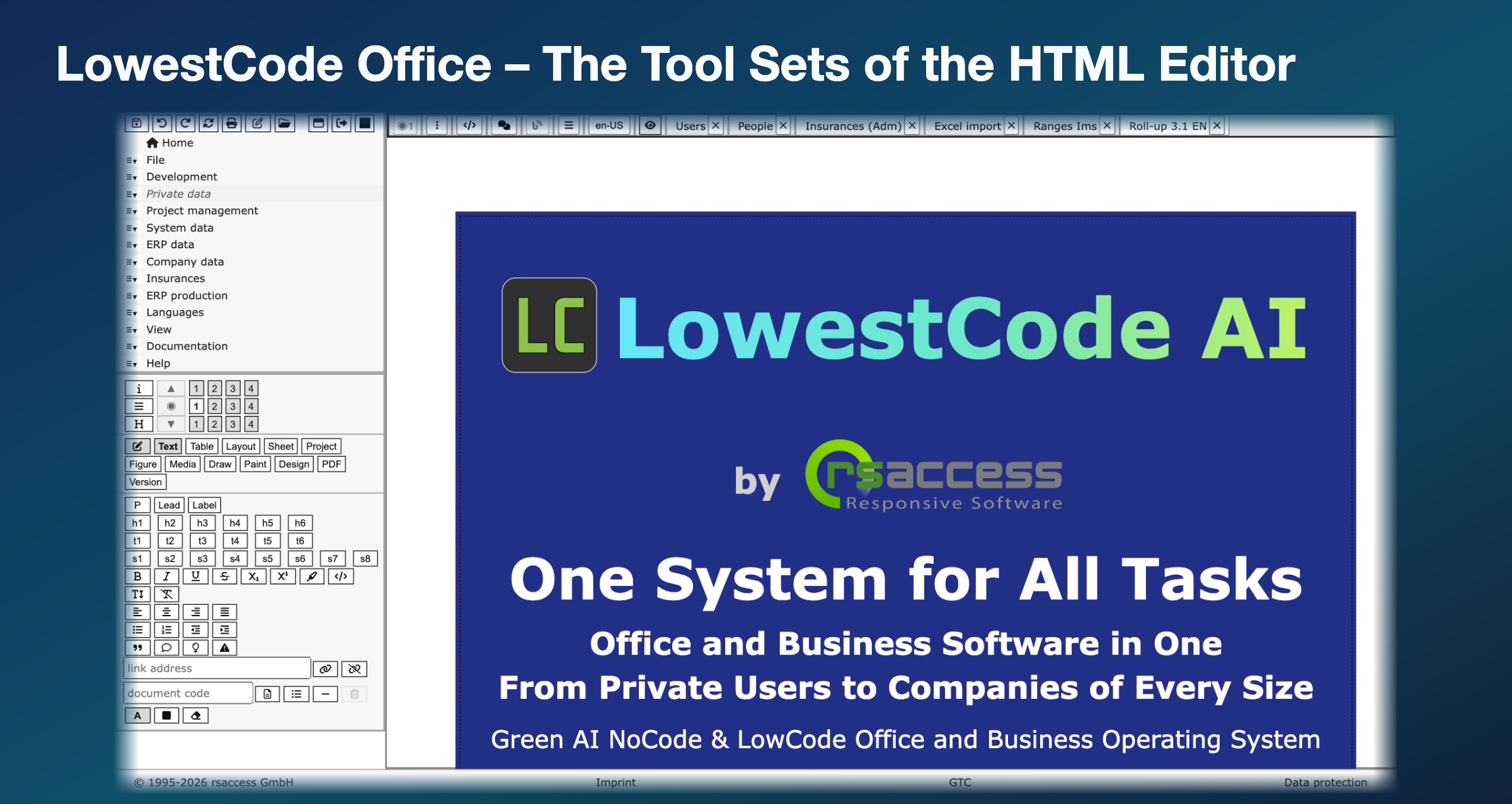
LowestCode Office Tool Sets Every tool set opens where the work is, and the set of the selected element opens by itself.
The HTML editor carries its tools in tool sets a person opens as Word opens its tabs: text, design, markdown, table, grid, sheet, project, figure, media, draw, paint, chart, PDF, layer, layout and version, and two more open the document's languages and its properties. Each tool is one entry of one vocabulary, so the person, the AI agent and an automation call the same operation, and a text, a sheet, a graphic and a design page share versions, languages, rights and design.
✅ Text
Text is written and formatted in the page: headings, sizes, marks, lists, notes, quotes, links, includes, footnotes and a table of contents, with the document's versions, languages and rights. In test since October: the tools at the selection and in the right-click menu, find and replace, and review comments on the text. Word and PDF import and export come in the Quest. Effort: 14 days.
🟨 Design
Design pages from postcard to poster and roll-up are in use, with bleed and crop marks for a print shop, printed at their paper size. The Design tool set and the page controls at the page come in the Quest.
✅ Markdown
The Markdown editor writes a document as Markdown source, with the composed preview beside it; the documentation of this site is written in it. The Markdown button opens it from the tool panel, for Markdown documents only.
🟨 Table
Well advanced: tables are written in the page: cells edited in place, rows and columns inserted, moved and removed through their handles, cells merged and split, a head row, ranges copied, pasted from Excel and formatted, and the body sorted by a column. Bound tables filter by value. Effort: less than a day.
🟧 Grid
Elements placed freely on a raster, overlapping in space. Comes in the Quest.
🟨 Sheet
Well advanced: a sheet stands inside the document with its formulas, values and chart. Rows and columns are inserted and removed and cells cut and moved with the formulas following, ranges are filled and pasted from Excel and Google Sheets, and a column takes percent, decimals and its width. Formulas compare, decide, join texts and sum and count by condition. The formula line above the sheet and Excel import and export come in the Quest. Effort: 6 days.
🟨 Project
Board, timeline and calendar of a project stand inside a document, and every move of a card or a date is checked by the task rules. Quick actions at a card come in the Quest.
🟨 Figure
Pictures from the document store with search and upload, graphics, captions, references, figure names and numbering, and 3D models that turn in the page. The import of pictures and models from Adobe, CAD and Blender tools comes in the Quest.
🟧 Media
Audio and video inside the document. Comes in the Quest.
🟨 Draw
Vector graphics with shapes, words on several lines, line width, order and grouping on a snapping grid, colored from the palette of the theme. Handles at the shape come in the Quest.
🟧 Paint
Painting on pictures. Comes in the Quest.
🟧 Chart
Charts and diagrams as elements of their own; a sheet already draws its chart. Comes in the Quest.
Every print is a PDF beside its document, its text set as the page shows it and its graphics as vectors. PDF import, forms and signature come in the Quest.
🟧 Layer
Every element on its layer, with stacking order, visibility, name and transparency. Comes in the Quest.
🟧 Layout
The print layout and the presentation: page size, orientation, margins, columns and breaks. Comes in the Quest.
🟨 Version
Every change can be walked back over its stepping stones, and every saved state stays as a version. In the panel a person picks the version to view, gives it a comment, raises its number to start a new one, and holds or locks it for release; a locked version opens read-only. Code and source files kept in a repository show their change history: who changed what and when. A translation follows its master block by block. The stepping stones and the change history as lists in the panel come in the Quest.
🟨 Languages
Lists the languages a document is written in, the one on screen marked, in the system's own form, so every field keeps its checks and rights. Built and waiting for its human test, so far for the system's own documents. Adding and removing a language in the panel comes in the Quest.
🟨 Properties
Opens the details of the document and its version, owner and rights included, in the system's own forms, so every field keeps its checks and rights. Built and waiting for its human test, so far for the system's own documents.
🟨 Forms
Well advanced: forms and reports are generated by the form generator, not programmed, with their data bound and their rights kept. Not a tool set of the editor, but part of Office.
✅ Secure Document AI Chat Agent
Every document has its AI chat agent. It helps with the harder document work, and because it knows the whole system in detail, its help goes deep. Its changes are proposals the owner releases. It writes the automations of the built-in RPA, which their owner approves before they run, built to replace Microsoft VBA macros and more. In the cloud, AI support comes under its own terms.
✅ Office Design
Theme, format, font and size are chosen independently and generated from the database, and a document takes the chosen design without being rewritten. The website, the documents and the shops share it; design variants for the shops come in the Quest. Effort: 3 days.
✅ Office Website
This website is a LowestCode document: the AI agent writes it, the system versions and delivers it, and its evidence pages come straight from the documentation. Its look comes from Office Design. Effort: 2 days.
LowestCode Office‑Sheet A sheet is part of the document, with its formulas, values and chart, not a separate file.
Office-Sheet puts calculation where it is read: a sheet stands between the paragraphs of a document, keeps its formulas as its source and shows their values and a chart generated from its cells. It shares the document's rights, versions, languages and design, and its translation follows the document.
Working today
The sheet in the HTML editor: formulas stay visible in the formula bar and in the selected cell, the composed document shows the values and the chart. Rows and columns can be inserted and removed and cells cut and moved, and the references of every formula follow them, fixed references as in Excel. A value or a block copied from Excel or Google Sheets is pasted in one step, a range is filled down or right, and a column takes percent, fixed decimals and its width. Formulas compare, decide with IF, AND, OR and NOT, sum and count by condition with SUMIF and COUNTIF, and join and cut texts. Numbers appear in the format of the document's language, and errors are named in words, not codes.
In preparation, built in the Quest
Excel import and export, dates, more functions and number formats, and merged cells, so that a company's calculations live in its documents instead of separate workbooks.
Built for full RPA
Like every LowestCode document, Office-Text and Office-Sheet are built for full RPA, robotic process automation: every edit is one named operation, the same one a person uses in the editor and an approved automation will run. The automation of documents is in preparation.
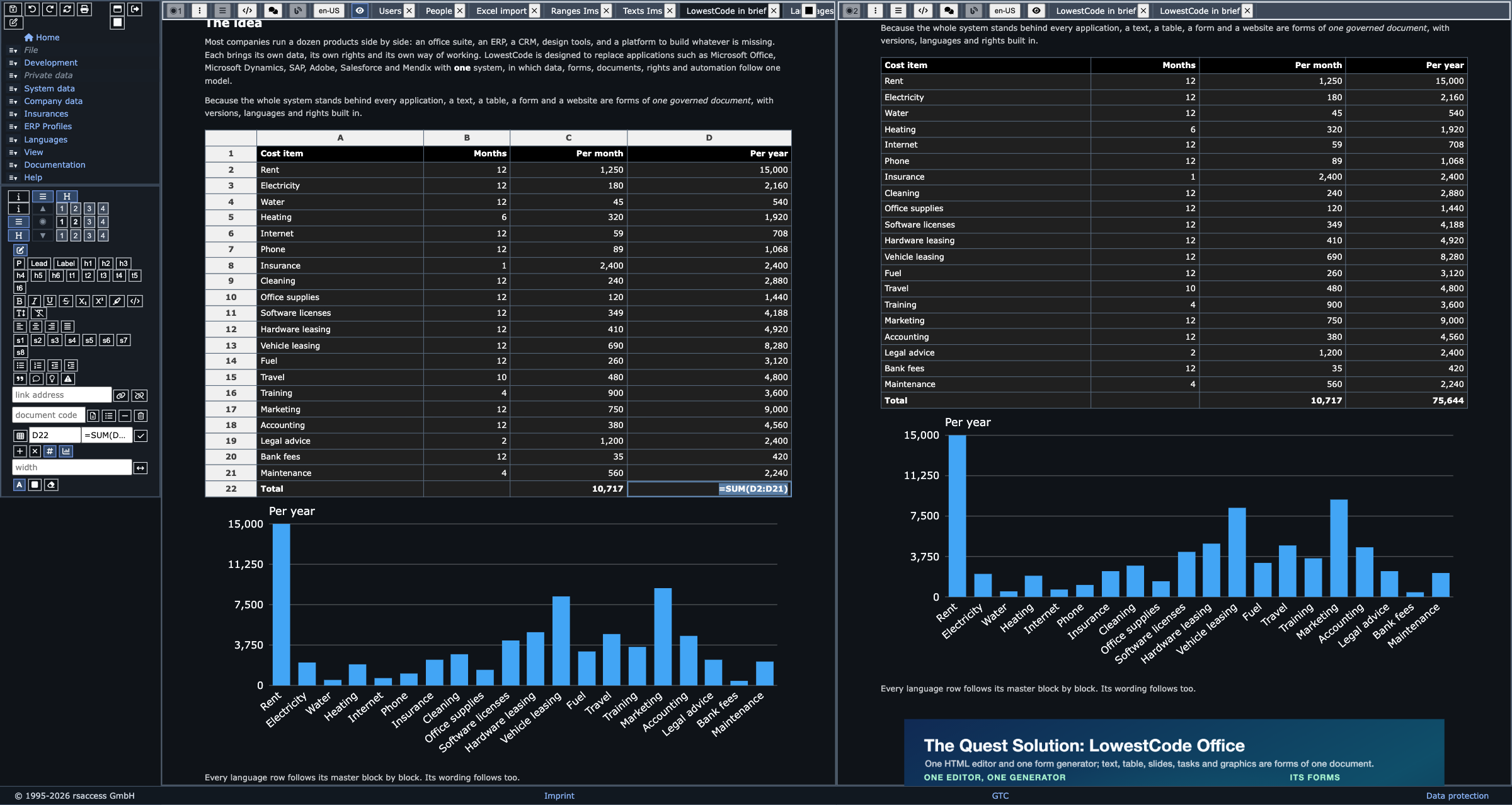
- Formulas as source
- Values and chart
- Inside the document
- Built for full RPA
Office in, Office out Files come in and go out; inside, everything is one governed document.
Word, Excel, PowerPoint and PDF are formats LowestCode Office imports and exports with its own means; the document itself, with its rights, versions and languages, stays in the system. Its goal is that a company needs no Microsoft Office for its internal work, one area of work at a time, while files for customers and partners keep their usual formats.
In production today
Excel workbooks are read and imported for defined insurance products, in production since 2024.
In preparation, built in the Quest
Office-Text, text documents with Word and PDF import and export; Office-Sheet, table documents with Excel import and export beyond the defined products; presentations with PowerPoint import and export.
All product names are trademarks of their respective owners.
An ERP for industry, from the order to the machine Trade, production, machine building and logistics in one system, built on a real industrial business.
We build the ERP on a real business: a metal profiling company that trades and sells online, profiles steel from the coil, sends profiles out for coating, builds machines for itself and for its customers, maintains them, takes on robot automation projects, and runs its own logistics and transport. Its products, categories, parts lists and packaging come from the ERP that business has used. In the Quest we simulate it as an international group with production locations in England, Germany, France and Saudi Arabia, each a company of its own in the one system.
Working today
Sales and purchase documents from the offer and the request to the credit note, the stock moves of deliveries and receipts, the journal entry of every invoice, any number of web shops, and the real product master with its categories, parts lists and packaging. In test, the web shop in production.
Built in the Quest
Production from the coil to the packaged profile, with profiling, cutting to length and packaging; logistics and planning.
Planned
Raw material and resources management, coating as a service, machine building for customers with multi-level parts lists and drawings, machine maintenance, robot automation projects, transport tours with own trucks or a carrier, and business between the companies of a group.
Web shops inside the ERP What a business gets: one system for its shops and the back office.
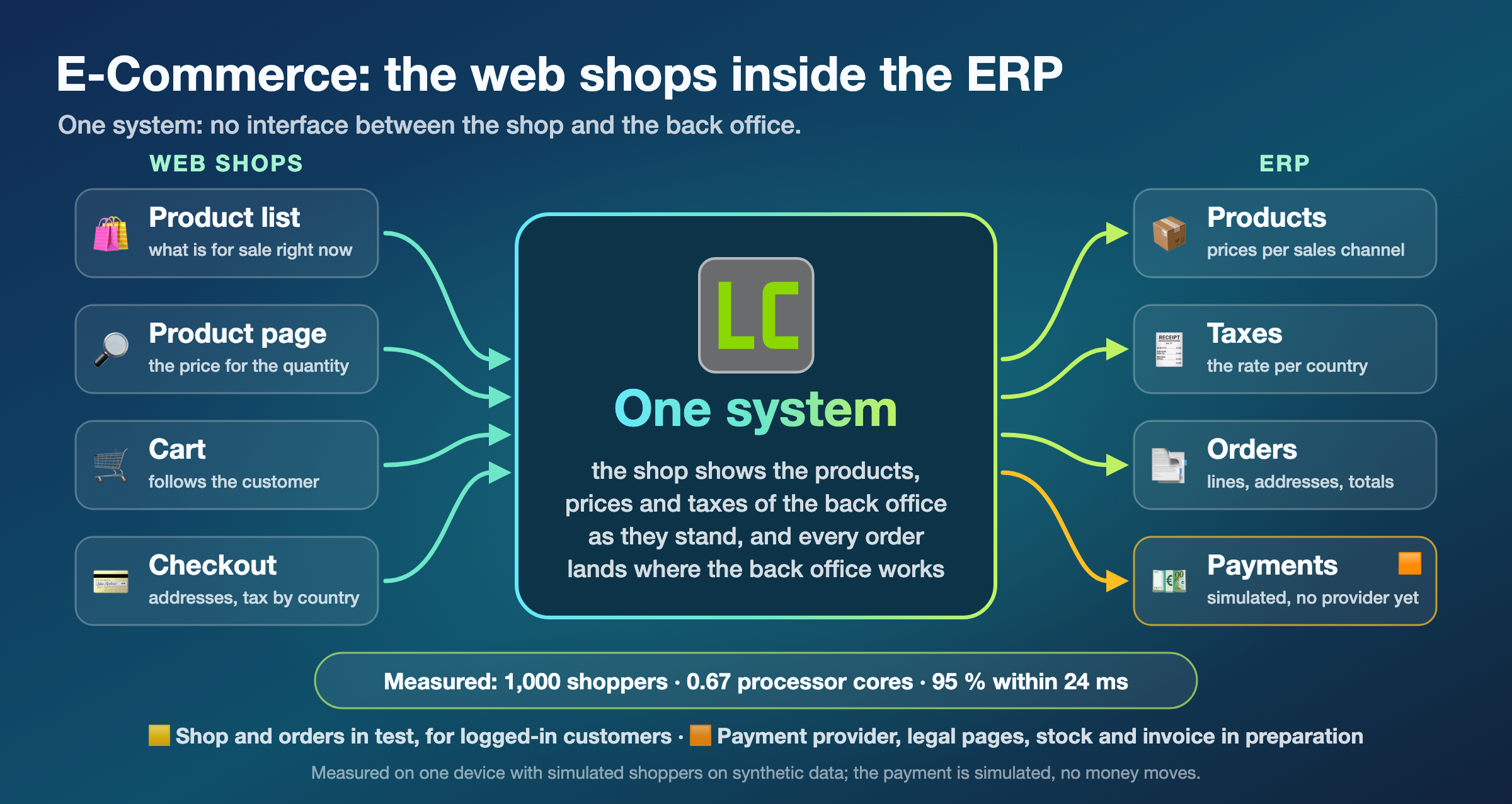
A web shop usually stands beside the ERP, joined by an interface that copies products, prices and orders back and forth, and every copy can be out of date or fail. In LowestCode the shops are part of the ERP: their pages show the products, prices and taxes the back office maintains, as they stand at the moment of the view, and every order lands with its lines, addresses and payment where the back office works with it.
Catalog
The products for sale with their pictures and the price of the shop's sales channel, found by category or search, and on the product page the price for the quantity ordered; today in production for logged-in customers.
Cart
The cart follows the customer from visit to visit, and every line is repriced when its quantity changes; a cart left untouched for 30 days is set aside.
Checkout
Billing and shipping address, the tax rate of the delivery country, every line recalculated from the current price; the order is stored in the ERP with its lines, its payment and its delivery. When the seller ships it, the goods are booked out and the invoice is issued, and the customer finds the order confirmation, the delivery note and the invoice on the page. Today the payment is simulated and no money moves; a payment provider and the legal pages of the checkout are in preparation.
As many shops as you need
One company runs any number of web shops. Each shop is defined by the product categories it offers, a category may stand in more than one shop, and all of them sell from the same products, prices, taxes and orders of the ERP. Live today: the common shop with 50 everyday products; an industrial shop follows.
Your design
The shop pages are documents of the system, so they take whatever theme the company chooses, with its colors, fonts and formats, light or dark. We built the function first; design variants for the shops come in the Quest.
Built in two days
The AI agent created the shop by chat in two days: the product, price, tax and order structure of the ERP, the cart and checkout actions, the shop pages and a first load test. We set the direction and reviewed. The pictures and the larger load tests followed on the third day.
We load-tested the shop with 1,000 and 5,000 simulated shoppers: at 1,000, standard response times of 8 to 24 milliseconds, and the 95 % energy and server hardware economy in line with our insurance load test. Details in the load test report.
Sim-Test: synthetic data for every proof What a company gets from it: data checks, security, load checks and planning simulations.
Every company needs this, and most ignore it: software has to be proven before real data and real money depend on it, and proven without handing customers' data to developers, testers or an AI. Sim-Test makes both possible: synthetic data in the shape of your business, generated from your own structures, so that test data follows every change and no separate data model has to be maintained, and repeatable, so that a second run tells the same. Four uses, from the first day to the long run.
Data check
See that your forms, imports, calculations and reports do what they should, on data that looks like yours and belongs to nobody. Today: create a test environment from the development data in one step, copy a record with everything that belongs to it or a company's whole development data set, and generate a repeatable data set of users, customers, offers and a product catalog. In the Quest: generated data for any table, with the edge cases a real year brings.
Security
Customer data stays in production. Developers, testers, trial users and the AI agent work on synthetic data in separate environments, and no path leads back. In the Quest: anonymization inside the customer's own production, operated by the customer, so that a real case can be studied without a real person in it; the result stays with the customer.
Load check
Know what your installation carries before go-live, not after. The AI agent sets up the test environment and its data, runs the simulated users and compares the result with what it should be: every answer is checked, every order recomputed, and a load that grows faster than the users points to its cause. Our web shop test with 5,000 simulated shoppers found three weak spots this way, a connection pool that locked up, a missing index and a cache reload, each fixed the same day and long before go-live; the load test of the next section ran the same way.
Planning simulations
Play a plan through before it happens: a year of orders, stock movements and invoices in the shape of your business, generated at the volume you expect and run through your real forms and reports, to see what the plan does to capacities, deadlines and cash. In preparation, built in the Quest on the generator for any table.
95 % less energy and server hardware on average Documented resource efficiency: own load measurements and estimated sizing for six leading business systems; SAP comes closest with in-memory.
LowestCode keeps about one core busy for 1,000 users, measured; sized with headroom and a standby, that is four cores, eight with high availability on two sites. Five of the six other systems need far more, estimated from their published sizing rules, benchmarks and typical landscapes.
- 1.4 billionrows read by the database in one run
- 30 minutesof full load
- 171,000checks of the answers, none failed
- 9 to 136 msstandard response time: 50 % to 95 % of the requests
- ≈ 5 wattsprocessor power, load generator included
The web shops were measured the same way; their figures stand in the e-commerce section and the load test report.
The numbers, their sources and the measurement are on these pages; no competitor product was measured. All product names are trademarks of their respective owners.
A structured innovation portfolio grounded in working software Deterministic AI, internationalization, digital sovereignty, and measurable efficiency.
We have structured a portfolio of 94 innovations and innovation candidates, including 43 system-level architecture innovations (A-category). They rethink how database semantics, documents and interfaces, automation, AI governance, security, and deployment work together.
On this basis we are preparing a research grant application to the German research ministry (BMFTR, formerly BMBF) and are looking for a university partner: companies are funded at 50 to 70 %, universities up to 100 %. The project validates what the working system shows today: energy efficiency, security by design for the EU rules, and full and secure AI integration in application creation and documents. Our thesis: AI needs an integral, compact system with governed controls. LowestCode is built that way, and LCP controls every step.
-
Customers
From private users to companies of every size, insurers and organizations: modernize one valuable workflow with a practical delivery path.
-
Developers
Build and improve governed applications with inspectable tools.
-
Universities
Study reproducibility, AI control, efficiency, and multilingual systems.
-
Investors and partners
Support customer-led growth and the validation of a reusable platform. Office and ERP are the core markets; Gartner forecasts USD 58.2 billion for low-code technologies worldwide in 2029 (forecast analysis of November 2025).
AI providers and cloud hosting
Offer the LowestCode Office and Business Application as your own application layer. Your model becomes the agent that creates and maintains every application throughout its life, and LowestCode keeps it on track: it prepares the agent, checks every step, and decides the rights before anything runs. Every seat adds recurring revenue on top of your models and hosting. Terms are open, from distribution to deeper collaboration, and every cooperation starts small, with a technical review or a pilot.
Implementation partners
Bring LowestCode to your customers: insurance modernization, Excel and VBA migration, and business applications. The AI agent does the coding, and your team guides it.
Self-learning, built to continue
LowestCode learns as a system with every accepted task, without training an AI model, and deterministic controls keep authority, auditability and rollback. A governed step is designed to run 10 to 100 times faster than an AI agent reasoning it through, and more safely: within narrow controls, with the owner and user rights applied to every step. The knowledge lives in the system, not in one head, so a new agent or a partner team picks it up from there.
AI-for-AI: one documentation, two uses
LowestCode's documentation is written by the AI agent for the AI agent: compact, structured and complete. It covers the whole system and states for each part what is built and what is planned. That gives it a second use. The same agent explains the system to people in detail: a developer asking how a rule works, a specialist joining a project, a partner team getting started. The answers come from the current documentation, not from a manual that fell behind.
LowestCode in short One integral, compact system for Office and business applications, and LCP controls every step. Many problems solved.
In use and measured today
- ✅Ten years of development, proven in real use: insurance software licensed and in production since 2024.
- 🧠We don't write code anymore: since September 2026, coding, project management and testing run 100 % by AI chat, on the NoCode & LowCode (NCLC) system with the LowestCode Communication Protocol (LCP), which checks each request before it runs.
- ⚡About one busy core for 1,000 users, measured: in one 44-minute load run the database reads more than 1.4 billion rows, and the device does not even get warm.
- ⚡Green tech: 95 % less energy and server hardware on average than six leading business systems, from our own load measurements and estimated sizing for the six; SAP comes closest with in-memory.
- 🌍21 application languages from the start, and each partner can add languages or define dialect variants; right-to-left scripts, time zones and country formats are built in.
- 🆓No license fees for components: every third-party component is free open source. AI agents and cloud hosting are external services with their own terms.
How it works
- 👥Power users deliver, IT experts guide and approve, and the AI agent does the coding.
- 🏅One rollout and contribution chain: System ⬌ Professionals ⬌ Organization ⬌ User. Partners build independently, and contributions travel back up in a controlled way.
- 🔁Workplace, development IDE and test environment in one: the test environment is independent of production and always available; you build and test on synthetic data, customer data stays in production, and changes can be validated and reversed.
- 🧪Sim-Test, which every company needs and most ignore: data checks, security and load checks on synthetic data in the shape of your business, while customer data stays in production; planning simulations follow in the Quest.
- 🛡️AI and cloud security with data protection, each designed for its EU rules: the EU AI Act for the AI, GDPR and the EU cybersecurity rules for the cloud.
- ♻️Self-learning by design: LowestCode learns with every accepted task, without training an AI model; a governed step is designed to run 10 to 100 times faster than an AI agent reasoning it through.
- ❤️AI-for-AI documentation: written by the agent for the agent, covering the whole system and kept up to date with every change; the same agent explains the system to people.
- 🧩Cross-platform by design: Java / Kotlin for the system, Python for science and data science.
- 🗄️PostgreSQL as the standard database, SQLite planned for mobile, MS SQL and MySQL for compatibility tests.
What the Quest will show
- 🚀The Quest: one AI agent, guided by one human, creates an Office and Business Application in three months, October to December 2026, with monthly, public, verifiable proof.
- 📄One system for all common Office and business tasks: the Office application is on its way, to complement or replace Microsoft Office and Adobe tools.
- ⚙️Spontaneous RPA in the same system: the AI agent writes an automation when it is needed, the owner approves it, and LowestCode checks it and decides the rights before every run; an approved automation runs again on demand, without the agent.
- ⚡Designed to run core database and cloud operations 10 to 30 times faster than Dynamics, SAP, and classic ERP stacks; the Quest will measure it.
- 🤝Technology partners welcome now, before the Office and Business Application goes on sale after the Quest, in January 2027; a university partner is sought for a research grant application.
We set the direction. AI agents code. LCP controls.